

Hubble telescope helps discover a nearly invisible galaxy in rare image
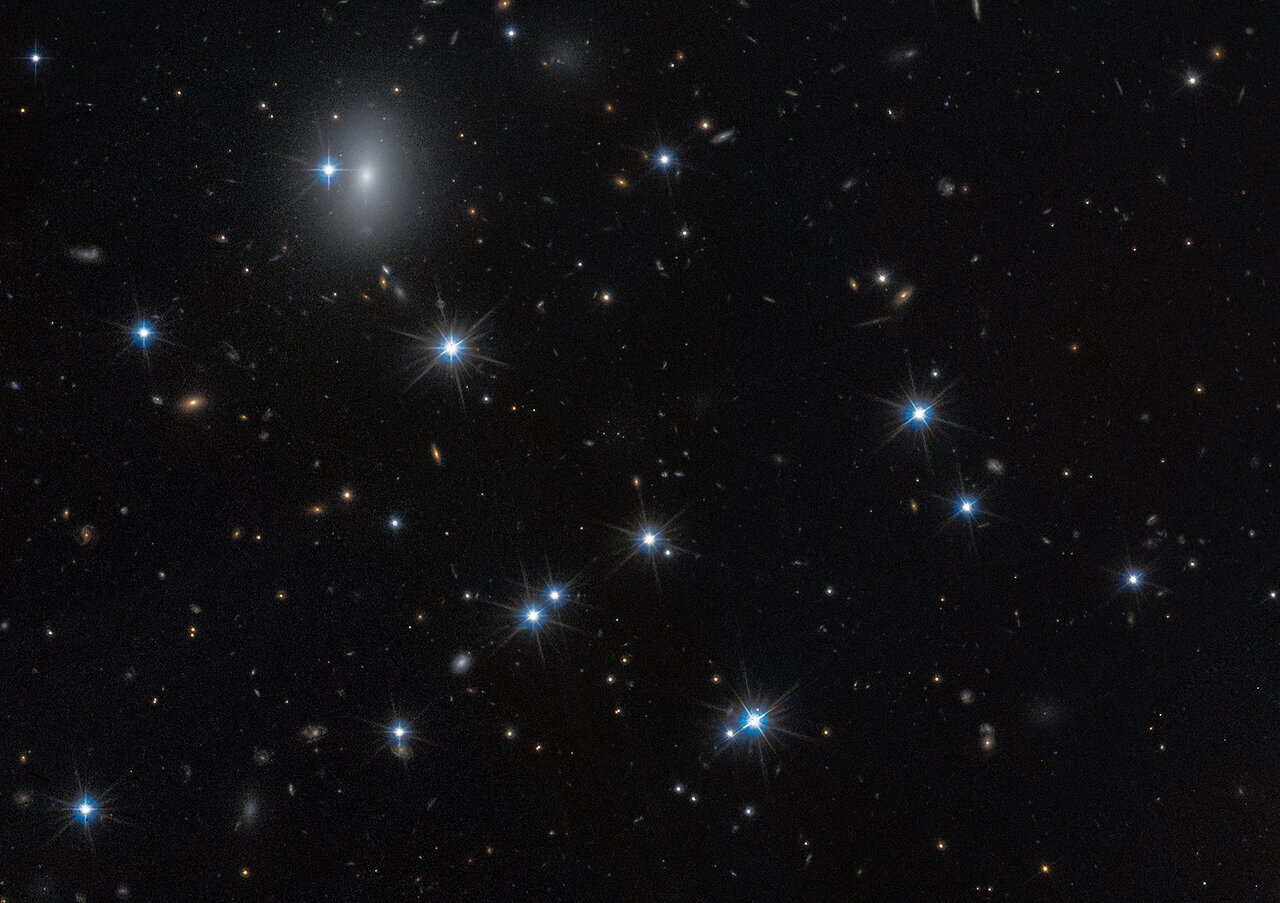
Astronomers have spotted something that barely glows yet holds a tight group of star clusters together, pointing to a hidden galaxy that almost vanishes into the background of space.
The discovery began with four lonely globular clusters — dense balls of stars — sitting unusually close to each other in the Perseus galaxy cluster, 300 million light-years away. Normally, these clusters orbit inside galaxies. Alone, they drift apart over time. Instead, this group stayed tightly packed, suggesting a strong gravitational anchor.
So the team asked a simple question: Could four clusters just randomly line up in the same spot? Scientists ran statistical tests and found that extremely unlikely. Something massive had to be holding the clusters together.
Researchers now believe this object, Candidate Dark Galaxy-2, or CDG-2, could be one of the most dark matter-dominated galaxies ever found. Dark matter is a mysterious material in the universe that doesn’t shine or interact with light.
“This is the first galaxy detected solely through its globular cluster population,” said David Li, a University of Toronto astrostatistics researcher and lead author of the study, in a statement.
The findings, which appear in The Astrophysical Journal Letters, invite the question of just how many other dim galaxies are out there. Astronomers rely on visible starlight to find galaxies, but if galaxies can be extremely faint, many could go undetected. Such an oversight could mean the estimates for how many galaxies fill the cosmos are woefully inaccurate. But the team’s technique may allow for the discovery of more galaxies lurking in the shadows.
Researchers analyzed images of CDG-2 from NASA‘s Hubble Space Telescope, the European Space Agency’s Euclid space observatory, and the Japanese Subaru Telescope in Hawaii. At first glance, they saw no obvious galaxy. The area looked nearly empty except for the clusters themselves.
While CDG-2 appears to have four globular clusters, the Milky Way has over 150. And the mysterious object dimly shines with the light of only 6 million suns, a pittance compared to the 20 billion or so of our own galaxy.
Don’t miss out on our latest stories: Add Mashable as a trusted news source in Google.
Regardless, it behaved like a galaxy, and its objects moved and clustered in a way that demanded an unseen gravitational source.
It wasn’t until astronomers stacked multiple Hubble images — layering them to maximize very dim signals — that they observed a soft glow surrounding the cluster group. The glow matched the position and shape of the cluster grouping, ruling out camera noise or image errors.
This Tweet is currently unavailable. It might be loading or has been removed.
Rough estimates suggest that 99 percent of CDG-2’s mass — nearly all of it — comes from dark matter.
Scientists have much to learn about galaxies suspected of being primarily made of dark matter. A paper published last year on Segue 1, a dwarf galaxy thought to be dark matter-dominated, found that it was hiding a supermassive black hole, a heavy cosmic object that is also invisible. It’s unclear how the black hole’s effects were overlooked in prior studies.
Mashable