


The interstellar comet gets stranger as scientists learn whats in it
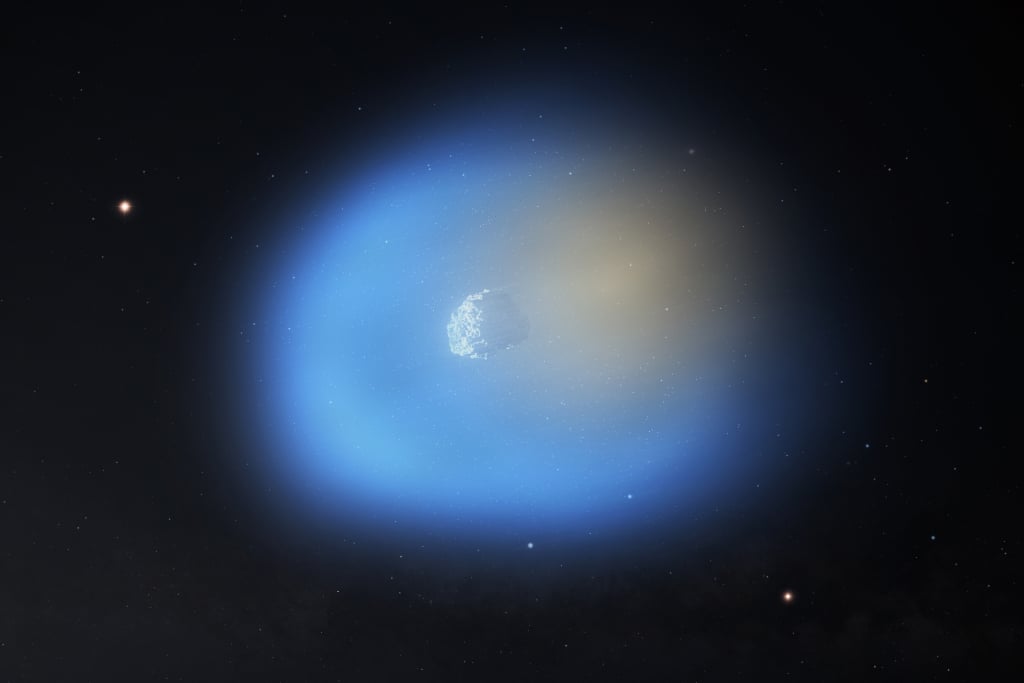
A comet swept through the solar system carrying a strange chemical recipe — one that has astronomers taking a closer look at what kinds of worlds might form around distant stars.
Astronomers studying the interstellar comet 3I/ATLAS detected two gases streaming off its icy surface: methanol, a type of alcohol molecule, and hydrogen cyanide, a compound made of hydrogen, carbon, and nitrogen. They spotted them using a powerful radio telescope network, called the Atacama Large Millimeter/submillimeter Array, in Chile.
Comets release gases in space when sunlight warms their frozen surfaces. The ice turns straight into vapor and forms a hazy cloud around the comet’s head, known as a coma. By measuring the gases in that cloud, astronomers can figure out what ingredients are locked inside the comet’s ancient ice.
What grabbed researchers’ attention wasn’t simply the gases but the balance between them. The comet appears unusually rich in methanol compared to hydrogen cyanide — one of the highest ratios astronomers have ever measured in any comet.
That matters because comets preserve the ingredients that existed when they formed, within the same disk of gas and dust that built a system’s planets. Because 3I/ATLAS formed somewhere else entirely, its chemistry offers a rare glimpse of how another planetary system differs from our own.
Around the sun, most comets formed where water ice dominated. But the chemistry seen in 3I/ATLAS hints that its birth environment may have favored the production or preservation of methanol-rich ice. That could mean its native region was colder or awash in stronger radiation.
Whatever the exact cause, the comet’s exotic chemistry suggests planet-forming disks can create icy bodies quite different from those in our own solar system. If those ingredients diverge from star system to star system, then the starting chemistry for planets — and, therefore, for life — may vary widely across the Milky Way.
“Observing 3I/ATLAS is like taking a fingerprint from another solar system,” said Nathan Roth, a professor at American University, in a statement. “The details reveal what it’s made of, and it’s bursting with methanol in a way we just don’t usually see in comets in our own solar system.”
The new research, led by Roth, was published in The Astrophysical Journal Letters on March 6.
Comet 3I/ATLAS came from another part of the galaxy and was later ejected — likely by a gravitational jolt from a planet or passing star — before drifting across interstellar space for hundreds of millions of years. Scientists only know about two other interstellar visitors having passed through our cosmic neighborhood: ‘Oumuamua in 2017, which turned out not to be a comet, and Comet 2I/Borisov in 2019.
Don’t miss out on our latest stories: Add Mashable as a trusted news source in Google.
The latest find reinforces the idea that alien planetary systems may make comets with different chemical fingerprints. Earlier observations with NASA‘s James Webb Space Telescope showed that 3I/ATLAS’ halo contains an unusually large amount of carbon dioxide compared to water — another odd trait.
Astronomers tracked the interstellar comet for several months in 2025 as it moved toward the sun, passing just inside the orbit of Mars before beginning its long trip back out of the solar system. Because it was traveling roughly 137,000 mph when it arrived, it was far too fast for the sun’s gravity to capture it.
Mashable