

A solar system is forming right before our telescopes
Astronomers are watching the birth of a solar system unfold right before them.
A young nearby star has revealed a second giant planet forming inside its dusty space surroundings. Scientists confirmed the new exoplanet around the star, known as WISPIT 2, using powerful telescopes, including the European Southern Observatory, and advanced imaging techniques.
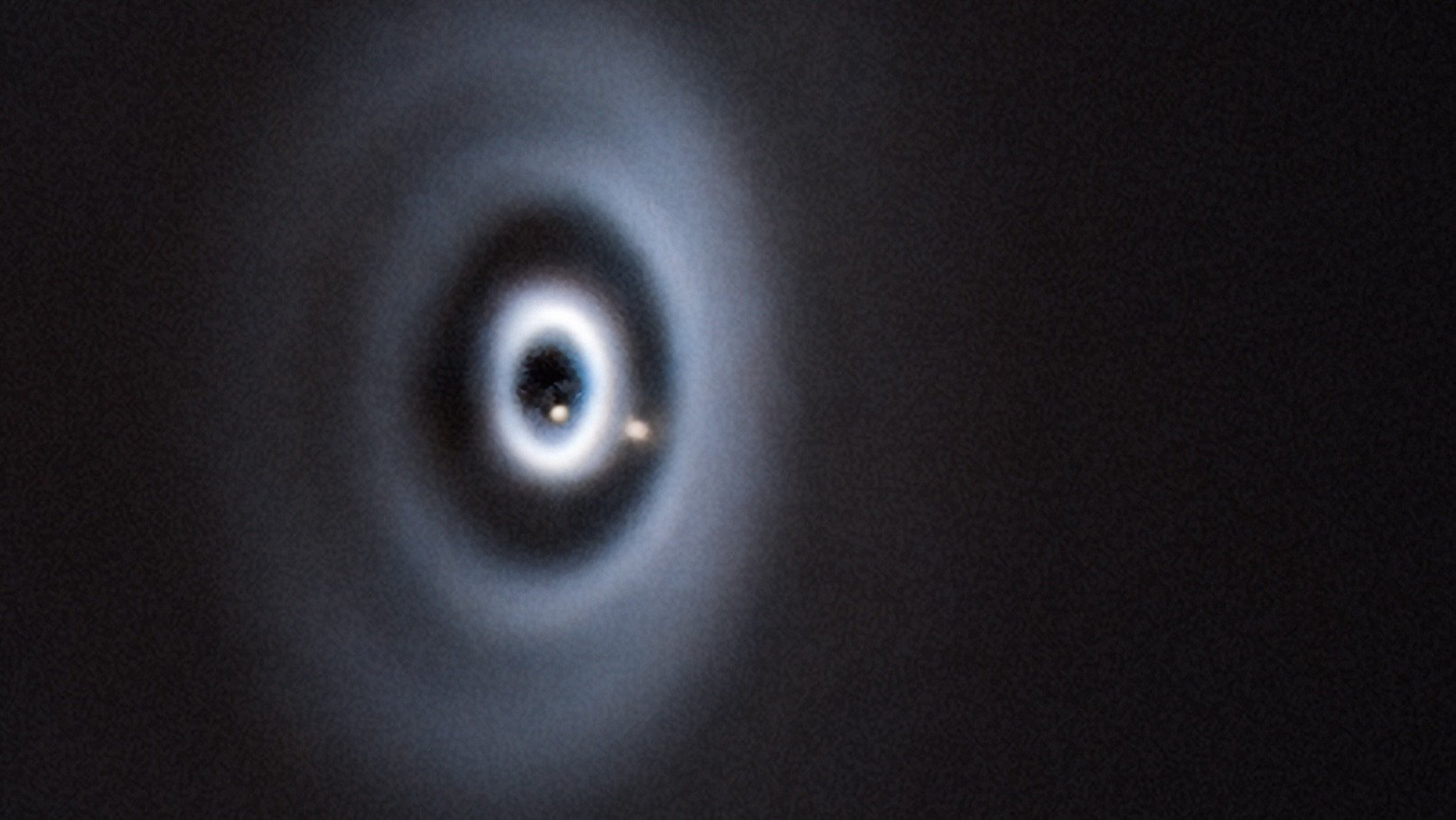
The discovery adds to earlier evidence reported last year that the system already hosted one massive Jupiter-like gas giant. Together, the two worlds, WISPIT 2b and WISPIT 2c, sit inside a wide disk of gas and dust marked by bright rings and dark gaps — the kinds of features scientists often link to planet formation.
Directly spotting planets while they are developing is extremely difficult. By observing WISPIT 2, just 5 million years old, scientists have a case study to better understand how planetary systems — including our own — begin and evolve. Each new detection helps researchers test ideas about how giant planets grow and shape their environment.
“WISPIT 2 is the best look into our own past that we have to date,” said Chloe Lawlor, lead author of the research at the University of Galway in Ireland, in a statement.
Following the discovery of PDS 70 and its orbiting worlds, WISPIT 2 is only the second system known where multiple giant planets are forming.
In most cases, astronomers detect distant planets indirectly, by measuring how they tug on their stars or block starlight. Here, researchers can actually observe the planets themselves and study the light coming from them.
Credit: ESO / C. Lawlor / R. F. van Capelleveen et al. composite image
The discovery of WISPIT 2c
WISPIT 2c lies much closer to its star than the previously known planet. While the first planet sits at a distance roughly 57 times farther than Earth’s distance from the sun, the second appears at about 14 times that distance. Even so, both remain far from their star compared to planets in our solar system.
They’re also much heftier than anything in our own cosmic backyard. WISPIT 2b is five times more massive than Jupiter, and WISPIT 2c is double that, according to the new research, published in The Astrophysical Journal Letters.
To confirm WISPIT 2c as a planet, the team used the Sphere instrument on ESO’s Very Large Telescope in Chile, which captured an image of the object, then followed up with the Gravity+ instrument on the VLT Interferometer: By splitting the planet’s light into each color of the rainbow — a technique known as spectroscopy — scientists identified which gases were present.
The researchers saw signs of carbon monoxide, according to the paper. This chemical signature, along with the overall shape of the light spectrum, suggests the object is a young giant planet. It also makes it unlikely that what scientists have detected is just a random clump of cosmic dust.
Tracking the planet’s position over time helped scientists rule out the possibility that it is a background object simply lining up by chance. Early measurements even hint at its movement, though more observations will be needed to confirm its orbit around the star.
“Finding two planets at such an early stage at the same time is almost like witnessing a rare twin birth,” said Frank Eisenhauer, project leader of GRAVITY+, in a statement. “This shows that planetary systems do not develop one after the other, but in parallel — much like our own solar system once did.”
Solar system in the making
The broader disk around WISPIT 2 adds to the intrigue. Multiple bright rings, gaps between them, and a central cavity all suggest that more planets could still be in the making. Some scientists speculate that systems like this may represent an early stage in the development of complex planetary families.
Don’t miss out on our latest stories: Add Mashable as a trusted news source in Google.
Researchers have noticed giant planets in several young systems seem to form at similar distances from their stars. This pattern raises the possibility of a Goldilocks region — i.e., not too hot or cold — where conditions favor the growth of massive worlds. For now, that idea remains tentative.
But future giant telescopes are expected to monitor WISPIT 2 closely, tracking planetary orbits, probing atmospheres, and watching the dusty disk’s changes. A smaller gap farther out in the disk is another tempting place to look, Lawlor said.
“We suspect there may be a third planet carving out this gap,” Lawlor said, “potentially of Saturn mass, owing to the gap’s being much narrower and shallower.”
Mashable