


A missing signal from hot exoplanets may have revealed a secret all along
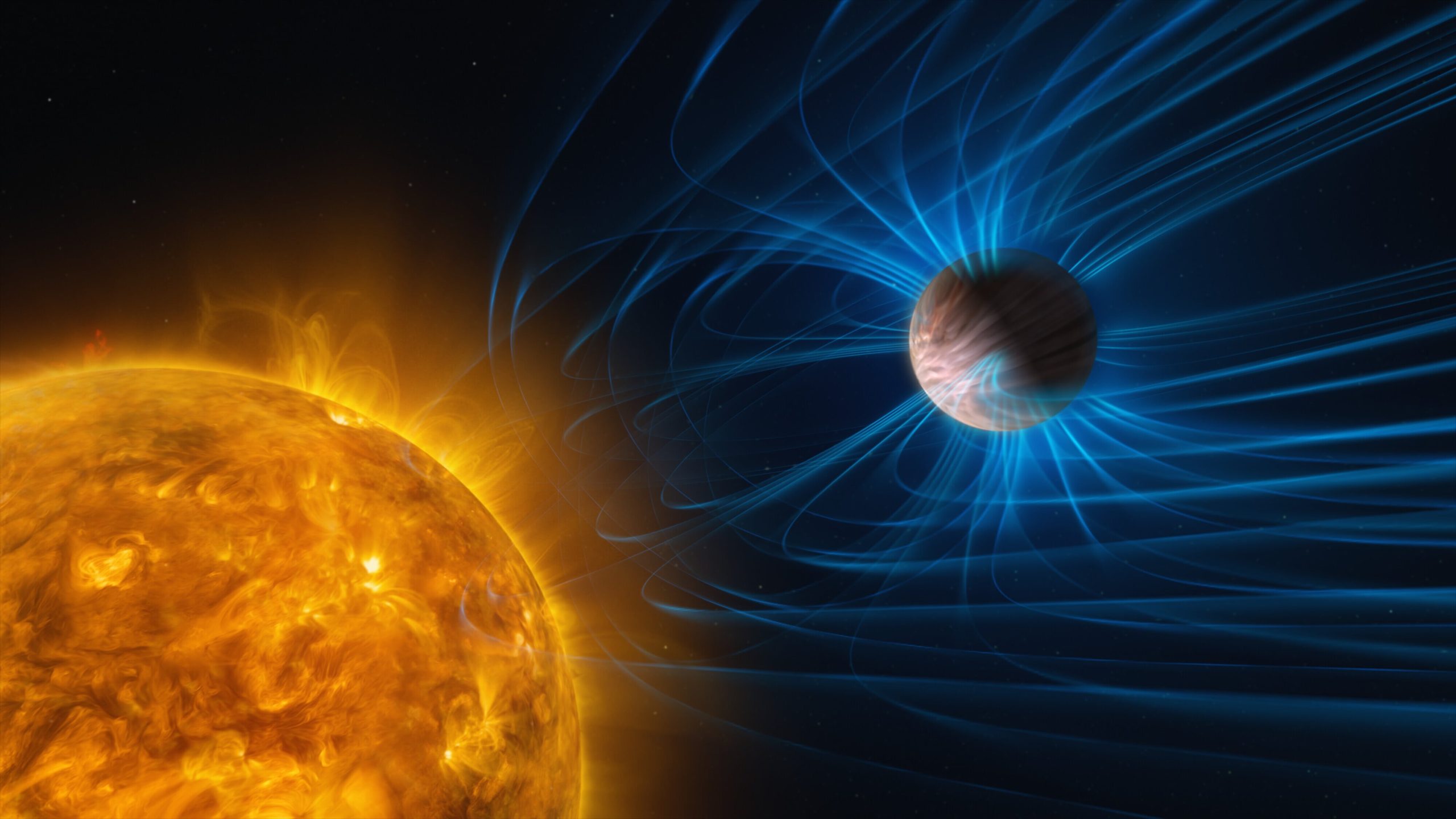
Astronomers have spent decades listening for radio signals from hot giant planets in space, suspecting these alien worlds would have strong magnetic fields like Jupiter to produce them.
Mostly, the scientists heard nothing.
Some theories have predicted distant exoplanets to have monster magnetic fields hundreds of times stronger than Earth’s, so their absence has been baffling. But new findings suggest maybe the silence itself is the clue. Maybe those planets don’t have enormous magnetic fields after all.
For the first time, scientists have inferred the strength of magnetic fields around exoplanets, and they did so in a wholly unexpected way. The results may help astronomers better understand how smaller, potentially habitable worlds make and keep their own magnetic fields.
“This breakthrough opens a completely new window on exoplanet research,” said Julia Seidel, an astronomer at the Laboratoire Lagrange in France and lead author of the work, in a statement. “It’s the first time we can compare the magnetic environments of other worlds — a key step toward ultimately understanding which planets can stay alive, keep their water, and perhaps even, one day, host life as we know it.”
The study, published in Nature Astronomy, didn’t start out as a quest to measure alien magnetic fields. The scientists were actually looking at wind behavior and how it differs across hot planets.
The team measured wind speeds in the planets’ atmospheres by studying how their iron content absorbed starlight: Faster winds shift the light more, while slower winds shift it less.
Using the European Southern Observatory’s Very Large Telescope in Chile and the National Science Foundation’s Gemini North telescope in Hawaii, the researchers homed in on seven ultra-hot gas giant planets that orbit so close to their stars that temperatures soar above 3,000 degrees Fahrenheit.
All of the planets in the sample group had a side much hotter than the other because one hemisphere always faces its star.
The temperature difference between the sides creates a climate completely different from Earth’s, along with extremely powerful winds. The speeds they found ranged from about 4,500 to 15,500 mph. For comparison, the fastest winds known on Jupiter top off around 1,000 mph.
When the research team looked at how the speeds varied with planet temperature, they saw a counterintuitive trend: the hotter the planet, the slower the wind.
“All things being equal, hot planets have more energy to accelerate the winds,” said Vivien Parmentier, a coauthor and professor at Laboratoire Lagrange, in a statement.
Credit: J.L. Dauvergne / G. Hüdepohl / ESO
The simplest explanation for that unexpected result is that global magnetic fields increasingly put on the brakes in those atmospheres. Given that magnetism resists the flow of the gas, it allows the researchers to then infer the strength of the magnetic field in each of the seven planets.
The team estimated that these magnetic fields are probably in the same ballpark as those found around gas giants in our own solar system — not, as some have thought, tens to hundreds of times stronger than Jupiter’s. This means the mysterious lack of radio signals coming from hot exoplanets may simply fit with weaker magnetic fields.
Though no one is looking for life on ultra-hot gas giants, the study of their magnetic fields may help scientists understand how smaller rocky planets make and sustain their own magnetism. Magnetic fields matter because they, along with atmospheres, act as shields against harmful radiation from host stars.
Not only is the magnetic environment likely affecting wind speeds for these distant planets, but it could also enhance their light shows. On Earth, our magnetic field guides solar particles toward the North and South poles, slamming them into gases in the air to produce luminous auroras.
“I like to imagine that some of these worlds have a sky filled … with vast curtains of colorful light,” said coauthor Bibiana Prinoth, based at ESO in Germany, in a statement, “dancing across a planet that’s half in perpetual day and half in endless night.”
Mashable