

Teenage Sex and Death at Camp Miasma review: Laughing in the face of elevated horror
Queer horror fans have a complicated relationship to the genre. Horror cinema is a place where we have seen ourselves reflected, but often as villains.
From the flamboyant mad scientists of James Whale’s Frankenstein and Bride of Frankenstein to the sapphic vampires of Dracula’s Daughter, to the trans-coded killers of Sleepaway Camp and The Silence of the Lambs, LGBTQ+ characters shimmer throughout the fabric of the horror canon. While such problematic portrayals might feel like antiques, they’ve nonetheless shaped the genre and generations of queer horror fans. And for these folks, American filmmaker Jane Schoenbrun has made Teenage Sex and Death at Camp Miasma.
Written and directed by Schoenbrun, Teenage Sex and Death at Camp Miasma celebrates the slashers and, through that, explores the complicated feelings of loving a genre that doesn’t reliably love you back. But that’s not all. They also offer a radical tonal shift from their moody films We’re All Going to the World’s Fair and I Saw the TV Glow, delivering a comedy that is part horny psychosexual thriller and part campy parody. The result is a film that is rollicking in queer joy, blood spray, and irreverent humor.
Yes, it’s meta, smart, and challenging genre norms. But calling Teenage Sex and Death at Camp Miasma “elevated horror” is to miss its point.
Teenage Sex and Death at Camp Miasma is a story of love, sex, and perversion.
Credit: MUBI
Hacks’ Hannah Einbinder stars as Kris, a 29-year-old queer filmmaker whose Sundance success has earned her a shot at relaunching the long-dead Camp Miasma slasher franchise. Like with I Saw The TV Glow, Schoenbrun creates a deep wealth of lore and fandom merch to flesh out the fictional IP within this story. Where I Saw The TV Glow’s central show had shades of Buffy The Vampire Slayer, Camp Miasma seems a mix of Sleepaway Camp, Friday the 13th, and Twin Peaks.
The first film was a grimy, ultra-bloody slasher flick that centered on a wide-eyed Final Girl named Billy Preston, who was stalked by a harpoon-carrying killer called Little Death (I Saw the TV Glow‘s Jack Haven). For Kris, Billy is the key to understanding how to revive Camp Miasma, and so she travels to meet the aging scream queen (Gillian Anderson), who lives at the “haunted summer camp” where the first film was shot.
Red flags like this don’t deter Kris, who is eager to walk in the footsteps of Little Death and his victims. But before long, Kris starts to realize that Billy isn’t interested in making another movie. She’s interested in Kris. Desire blooms between the two women, but inelegantly. And that’s the point.
Schoenbrun recognizes how horror can be ludicrous, with kills that turn severed human necks into fountains that shoot blood 30 feet in the sky, as if we are meat sacks full of cherry soda just waiting to explode. Sex they treat as similarly silly from the moment we meet the siren that is Billy Preston.
Anderson plays the reclusive actress as Norma Desmond by way of Dolly Parton in a David Lynch movie. She slinks around the cabins with perfectly manicured, bright red nails, her hair in big, tumbling blonde curls, and her wardrobe silky robes that beg to be stroked. But then, she’ll offer Kris a preposterously abundant plate of fried chicken, treating the accompanying dipping sauces as if they were oysters, ripe for vaginal allegory and campy foreplay.
While many might write Billy off as odd and flee this camp of red flags, Kris is drawn in because Billy is fearless, even in her strangeness. Through her influence, Kris not only reconsiders her Camp Miasma movie, but also her understanding of herself. Where Billy is a carnal creature who licks her fingers and speaks candidly of sex to a near stranger, Kris is shy and cerebral, far more capable of talking about “elevated horror” and transphobia in film than she is her own desires.
However, through her relationship with Billy, Kris learns to understand horror not just as her personal obsession, but also as a path to self-acceptance. How does a harpoon-wielding slasher, an avalanche of candy wrappers, and a Southern-fried recluse factor into that? Well, Camp Miasma’s killer’s name being “Little Death” is a pretty big clue.
We’re talking orgasms.
Gillian Anderson and Hannah Einbinder are a perfect match in Teenage Sex and Death at Camp Miasma.
Credit: MUBI
Teenage Sex and Death at Camp Miasma is gloriously irreverent in its approach to its influences. Schoenbrun name-drops or alludes to Sunset Boulevard, Psycho, Mulholland Drive, Bound, Friday the 13th, Sleepaway Camp, and more. But they do so with a rebellious joy that turns a transgressive backstory into a gorgeous portrait of nonbinary beauty, and an iconic final shot into a rebellious echo of pride.
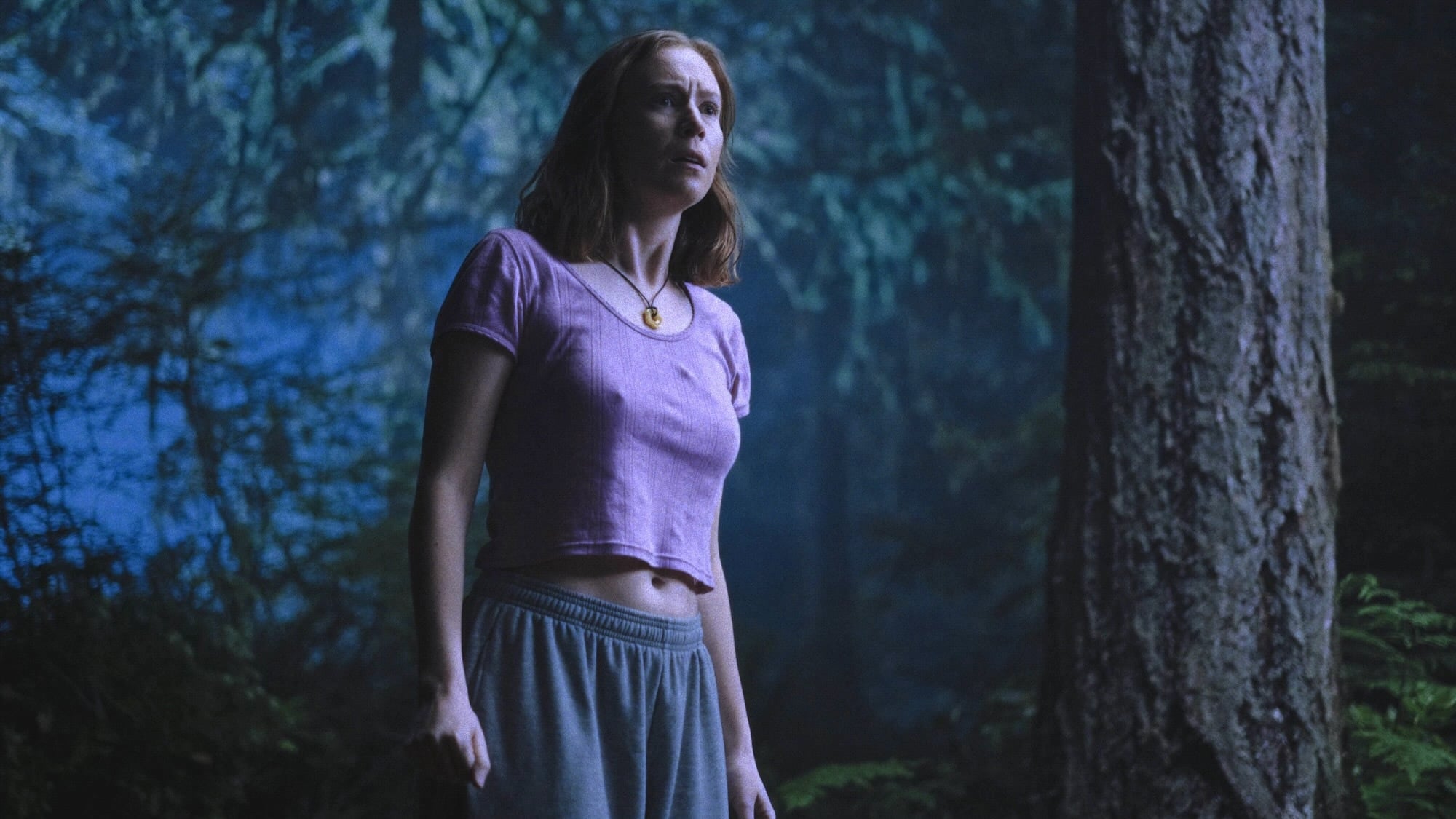
The cinematography of Eric K. Yue manages to weave together tones that go from earnestly amorous to unapologetically loony. A production design that blends a realistic camp setting with forest backdrops that are clearly painted challenges the audience to consider what is real and whether or not that matters. The music offers Psycho-reminiscent stings of strings, sultry synth keyboard, and a chaotic soundtrack that ranges from Counting Crows’ “A Long December” to Sade’s “No Ordinary Love” and Donna Lewis’ “I Love You Always Forever.”
It’s a bold blend of dark inspirations and cheerful pop. Anderson and Einbinder are entrusted to make it work, and they do. Einbinder steps out of the chaotic bisexual bravado of her Hacks heroine, embracing the timid sapphic who’s technically poly but low-key resents her partner’s (Jasmin Savoy Brown) boyfriend Thor (Aren Buchholz). Her intellectualizing and her filmmaking are where she feels comfortable, while Anderson’s Billy is bored by all that blather. Billy relishes flesh and touch, and so becomes a carnal mentor.
Together, their quirks make sense, building a world that others might see as bizarre, but which the queer (like a gas station attendant with a septum ring) will clock as wondrous. Like Lynch’s leading ladies in Mulholland Drive or Todd Haynes’ in Carol, these two actresses tug on each other, giving the film a sexual tension and emotional pull that is exhilarating. And then on top of that, they embrace the absurdity Schoenbrun has baked in, which reminds the audience earnestly that sex need not be taken so seriously. It can be silly, messy, sweet, and bloody, and it can shine a light on the most fucked-up desires of our queer little minds. And all of that can be celebrated instead of shame, with the help of a Little Death.
Teenage Sex and Death at Camp Miasma explores where queerness, self-acceptance, and horror collide. But it’s also a hell of a good time. Schoenbrun and their cast embrace the ghoulish delights of slasher slaughters, the titillating fun of their teen sex and death, and the radiant joy of finding pleasure in your own body. All this makes Teenage Sex and Death at Camp Miasma a knockout, from its first kill to its final thrill.
Teenage Sex and Death at Camp Miasma was reviewed out of its North American premiere at Newfest. The film will open in theaters on Aug. 7.
Mashable