



Japan and China just flew past asteroids. Heres what they saw.
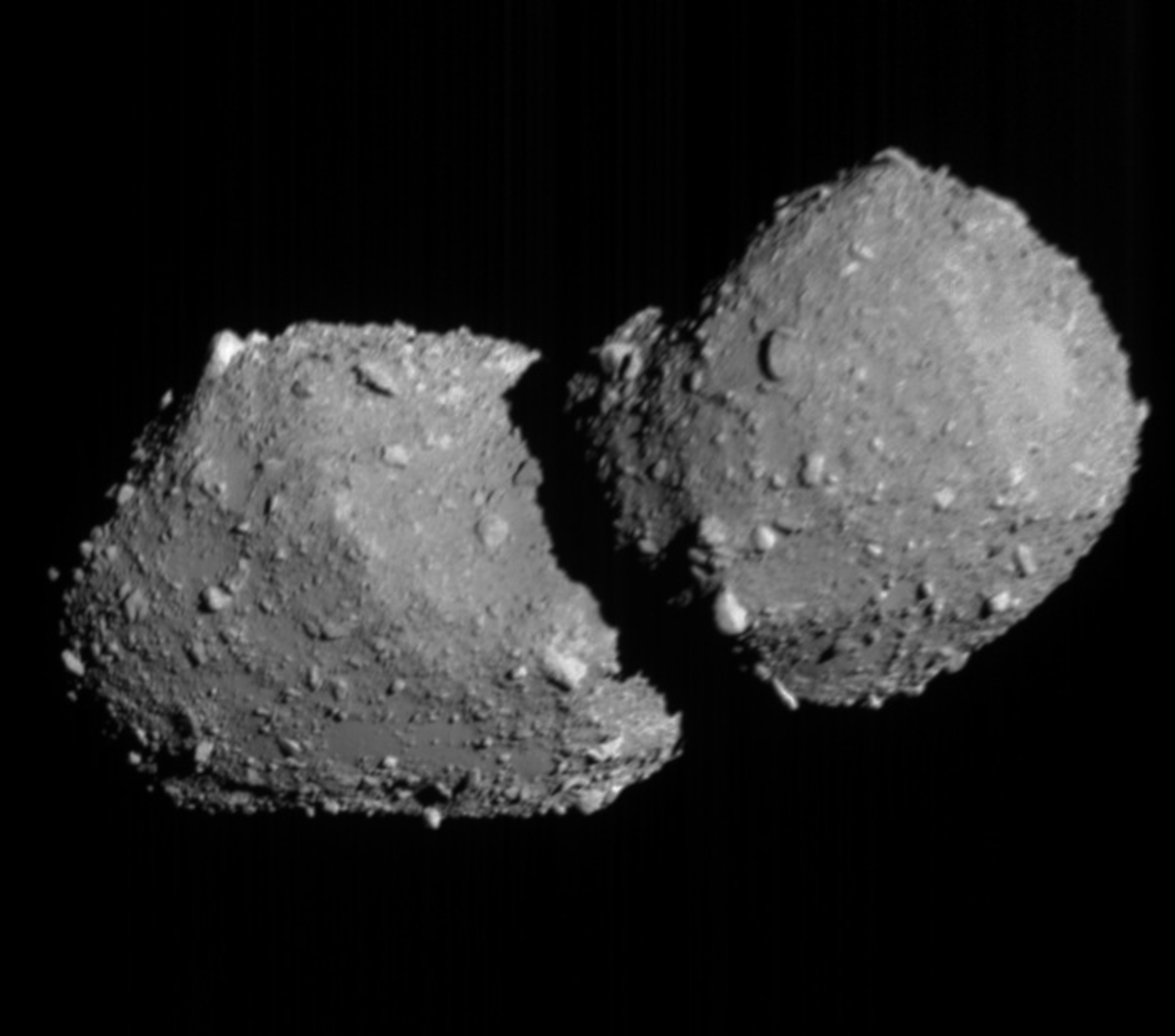
Within just three days of each other, Chinese and Japanese spacecraft got up close and personal with two different asteroids.
The China National Space Administration sent Tianwen-2 to visit Kamo’oalewa, a 300-foot-wide rock some call a quasi-moon of Earth, on July 2. The Japan Aerospace Exploration Agency, aka JAXA, sent its Hayabusa2 spacecraft by a 1,500-foot-wide space rock dubbed Torifune on July 5.
The missions, which each scored photos of their targets, show a thirst for knowledge about these dinosaur killers and how to potentially stop them, should one ever be on a collision course with our planet. Though neither of these so-called near-Earth asteroids is a threat, scientists and engineers hope to use these and other close encounters to prepare for potential dangerous ones in the future.
In a post on X, the European Space Agency congratulated both space programs for their successes while promoting its own Hera mission, a robotic spacecraft on its way to visit Dimorphos, the asteroid NASA‘s DART mission intentionally slammed into for asteroid target practice in 2022.
Asteroids are the ancient detritus leftover from the formation of the solar system about 4.6 billion years ago. They’re rocky objects that orbit the sun, mostly within the asteroid belt between Mars and Jupiter.
Unlike planets, asteroids didn’t grow large enough to become worlds of their own. The upshot is that they’ve kept some of that early material intact, serving as time capsules from the dawn of the solar system.
Credit: CNSA / Xinhua
For Tianwen-2, the journey to Kamo’oalewa took more than a year — roughly 400 days, according to Xinhua, China’s state-run news agency, which released the image Monday. Scientists used navigation data during the approach to refine their knowledge of the asteroid’s orbit. At the time, it was about 26 million miles away from Earth.
Though Kamo’oalewa, which means “oscillating celestial object” in Hawaiian, doesn’t orbit Earth, it’s sometimes known as a quasi-moon because it takes roughly the same orbital path as the planet around the sun. Some astronomers think it could even be an ancient blown-off piece of Earth from a long-ago collision — a chip off the old block, as it were.
The spacecraft has come within 12 miles of the asteroid. After studying it for several months, the mission will attempt to collect samples. If successful, China will be the third nation, following Japan and the United States, to bring home bits of asteroid rubble.
“Besides the intense scientific interest, this is another step toward utilizing the rich resources of accessible asteroids to boost the human settlement of the Earth-Moon system and beyond,” said Dale Skran, chief operating officer of the National Space Society, in a statement. “This type of exploration also helps us to plan the protection of Earth from larger rogue asteroid impacts.”
The Hayabusa2 mission reached asteroid Torifune, named after a god and ship in Japanese mythology, as part of its extended mission. Launched in 2014, the spacecraft has already visited asteroid Ryugu and returned samples to Earth in 2020.
This Tweet is currently unavailable. It might be loading or has been removed.
Because the spacecraft was traveling at about 3 miles per second, the flyby required a different navigation strategy from how it approached Ryugu. The Japanese space agency said engineers used a combination of images and radio tracking to guide the spacecraft. The peanut-shaped Torifune was about 62 million miles from Earth when the spacecraft reached it.
After their encounters, both missions intend to visit other targets. JAXA is sending Hayabusa2 to 1998 KY26, a 36-foot-wide asteroid. The journey there will take about five years. China plans to eventually send Tianwen-2 to comet 311P beyond Mars.
Mashable