


MLB All-Star Team Of The Century: The Greatest First-Half Performers Since 2000
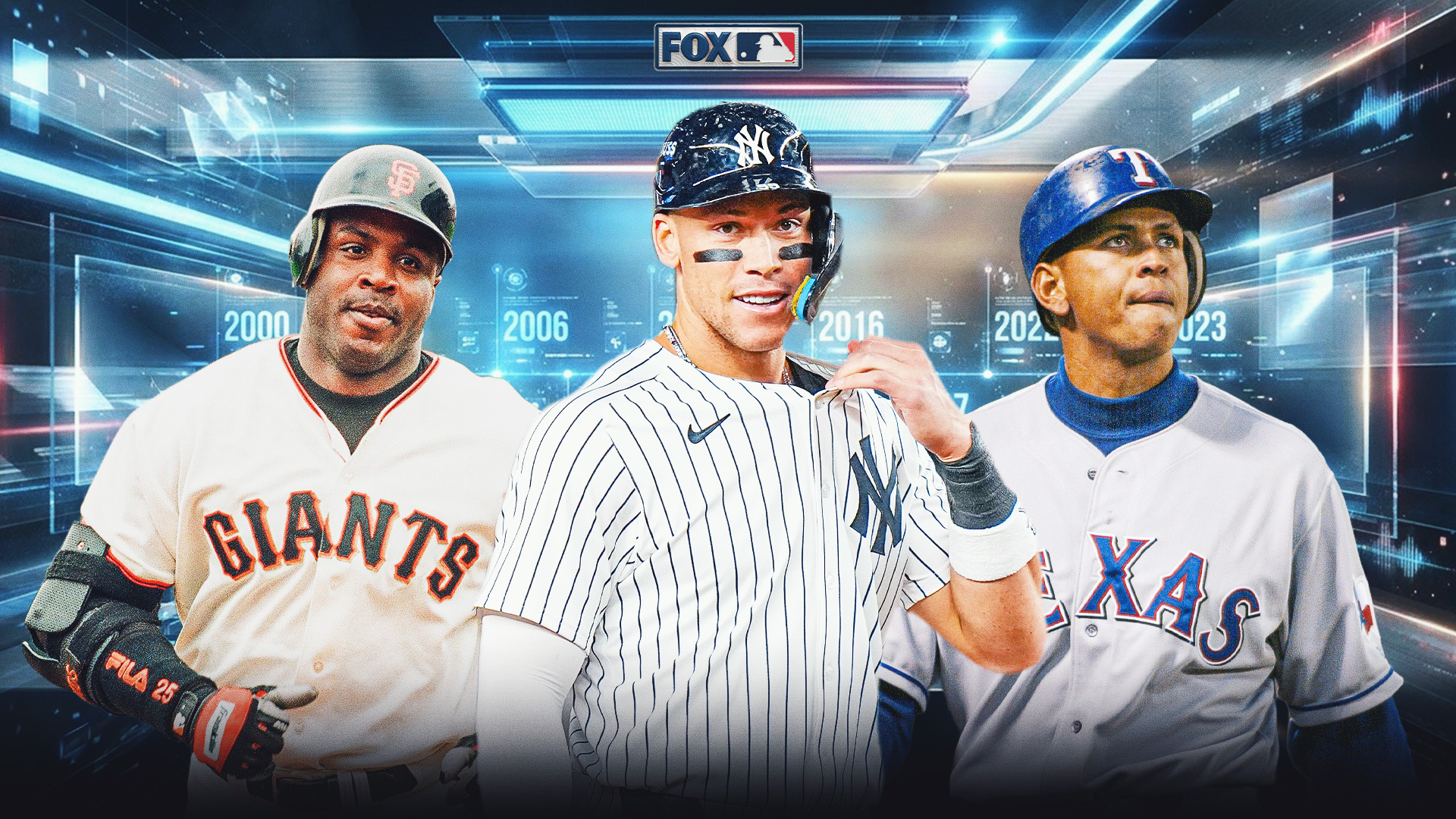
To celebrate the Midsummer Classic, we’ve built the All-Star team of the century, the ultimate 26-man roster based on first-half performance. We scoured the stats at every position to find the most impressive All-Star résumés since 2000. Some of the players who made our squad are household names you won’t be surprised to see, but there are a few surprises along the way. (One of these players was the best at his position this century but didn’t even make the roster for that year’s Midsummer Classic!) Here’s our 26-man roster, starting with a big name from last season behind the plate. All-Star Starting Nine By last season’s end, “Big Dumper” had set home run records for catchers and switch-hitters. His 60 dingers rank third all time on the American League single-season list, behind Aaron Judge (62 in 2022) and Roger Maris (61 in 1961). By the 2025 All-Star break, these were already all clear possibilities for Raleigh. He was slugging .634, with 38 home runs, 16 doubles, 10 steals, 82 RBI and 62 walks. On top of all that, he was catching every day and doing a fine job of it, too. Pujols was a safe guess for the Cardinals. The real question: which season? It’s tough to beat his 2009 campaign, when Pujols slashed an unreal .332/.456/.723 with 102 hits, 55 extra-base hits — including 32 homers — and enough plate appearances left over for 71 walks in 90 games. Pujols had plenty of first halves with the Cardinals that ranged from great to amazing, but none epitomized what he was capable of at his best better than his transcendent showing in 2009. Roberts was an underrated second baseman both before and after his 2005 breakout, maybe in part because he never quite reached those lofty heights again. His age-27 season — which featured his first of two career All-Star appearances — was fantastic, though, and difficult to replicate. In the first half of 2005, Roberts slashed .345/.416/.591 with 42 extra-base hits while going 18-for-23 on steal attempts and playing fantastic defense. By season’s end, his glove alone was worth two wins above replacement, and his bat nearly six. His second half looked more like the Roberts the Orioles got for the rest of his career — still great, but nothing more than that. You’d think Cabrera’s Triple Crown 2012 season would be the pick here for the Tigers, but his first half of 2013 was even better. In fact, his entire 2013 was better. Cabrera won his second straight American League MVP after slashing .348/.442/.636 with a 190 OPS+ — the 15th-best OPS+ of the century, and 11th-best for players not named Barry Bonds. Cabrera’s first half did most of the heavy lifting. He slashed .365/.458/.674 with 30 of his 44 home runs that year with 51 extra-base hits in his first 93 games. Cabrera won his third straight batting title, capping a four-year run during which he batted .337. Rodriguez won his first Most Valuable Player award in 2003, but his 2002 season was one hell of a warm-up. A-Rod would lead the majors with 57 homers, 142 RBIs and 389 total bases — and he did all that while playing Gold Glove defense at shortstop. In the first half alone, A-Rod slashed .305/.401/.607 with 27 home runs, 100 hits and 199 of those total bases, earning him his sixth All-Star nod. And it doesn’t matter for our purposes, but he was even better in the second half, with 30 homers and a .642 slugging percentage in 75 games. Bonds hit an MLB-record 73 home runs in 2001, and it’s impossible to do that without a monster first half of the season. He was a monster before the All-Star break that year, hitting 39 of those 73 homers in his first 81 games while slashing .305/.487/.826. Yes, you read that right: Bonds had a slugging percentage over 81 games of .826. He had 18 doubles to go with the 39 dingers, as well as going 7-for-8 on stolen-base attempts, racking up 79 hits despite pitchers avoiding him — Bonds already had 88 walks by the break — and driving in 73 runs even though opponents pitched around him even more with runners on base. Judge has been on an all-time tear since 2022. At no point in his career was this more evident than in 2025, when Judge won the “Slash-Stat Triple Crown,” leading the majors in batting average, on-base percentage and slugging percentage. Last season, Judge slashed 331/.457/.688 with 53 homers — his fourth campaign with at least 50 dingers — and won his third American League MVP. Before the All-Star break, Judge slashed an even wilder .355/.462/.733 with 35 of those blasts, beating out other Yankees performances of the century … mostly from himself. Part of what made the idea of the Red Sox trading Betts rather than extending him so absurd was his MVP-winning 2018 season. That year, which ended with the Red Sox winning the World Series, saw the 25-year-old Betts lead the majors in wins above replacement (10.7), batting average (.346) and slugging (.640). He also played all-world defense in right field and posted a 30/30 season five years before MLB changed the rules to make thievery easier for baserunners. In the first half of 2018, Betts slashed .359/.448/.691 with 108 hits, 51 of them for extra bases. Pronk! Travis Hafner never made an All-Star team, but this isn’t a list of the best All-Stars of the 21st century, and he absolutely should have been an All-Star in 2006 anyway. Cleveland’s DH slashed an absurd .322/.461/.650 with 25 homers and 43 extra-base hits in 83 pre-break games, punctuated by a June in which he got on base 46 times for a .485 on-base percentage. Plus, he did all of this despite the fact that, at the time, Progressive Park played as a pitcher-friendly ballpark. Hafner finished the season leading the AL in slugging and OPS, he led the majors in OPS+ and finished eighth in the AL MVP race. All-Star Reserves Rodríguez was the 1999 AL MVP, and he continued that level of performance into the new millennium. Though a broken thumb limited him to just 11 games in the second half of the 2000 season, his performance in the 80 games he played before the All-Star break was pure magic. Pudge slashed .366/.393/.708 with 25 homers and 55 extra-base hits — remember, too, that catchers didn’t play every day like this as a regular thing back in 2000. That was just something Rodríguez did in the middle of his career, before injuries became more commonplace for him. Starting in 1995, Jones made the NL All-Star team in five of six seasons, and he won an MVP in the other. It would be seven years until his next All-Star nod, but boy, did Jones make that one count, slashing .376/.472/.614 in the first half while hitting 18 homers. Due to injury, he wound up playing just 128 games in the 2008 season, but that first half helped carry him to his first and only batting title. His .364 average led all of MLB. Lee played in the majors for 15 years and hit .281 with 331 homers, 432 doubles, 104 steals, 1,078 RBI, 1,081 runs, 874 walks and 1,959 hits. For context, just 29 players in the history of the game have reached 300 homers, 400 doubles, 100 steals, 1,000 RBI, 1,000 runs, 850 walks and 1,900 hits. And yet, you’d be forgiven for thinking Lee was more of a one-hit wonder, considering just how staggering his 2005 season was with the Cubs. Lee led the NL in hits with 199 and topped the majors in doubles (50), batting average (.335), slugging percentage (.662) and OPS+ (174). In the first half alone, Lee slashed .378/.452/.733 with 27 dingers and 27 doubles. Football loves its ultra-huge and ultra-fast players, while in basketball there’s an obvious advantage to height and length. In baseball? All of the above helps, sure, but you can also be 5-foot-6 and under 170 pounds and still be a star, so long as you have the hand-eye coordination to make up for it. Altuve is one of the players who best exemplifies this separation between MLB and other major sports. In 2016, he led the league in hits (216) and won the batting title (.338). In the first half, Altuve slashed .341/.413/.542 with 14 home runs, 40 extra-base hits and went 23-for-26 on stolen base attempts. When all is said and done, Ramírez might end up being one of the best players to never win a Most Valuable Player Award. In 2018, en route to his second All-Star selection, Ramírez slashed a ridiculous .302/.401/.629 with 29 home runs while going 20-for-23 on stolen base attempts. His power would drop in the second half, but part of that was because pitchers would pitch around him. Ramírez ended up drawing 106 walks in 2018 after picking up 49 in his 63 second-half games. Tejada rose to prominence with the “Moneyball”-era Athletics, but it was in Baltimore where he produced most of his high-powered offensive seasons. That includes 2005, when he slashed .304/.349/.515 with 26 homers and an MLB-best 50 doubles. Tejada earned an All-Star nomination thanks to a monster first half, when the veteran shortstop hit .329 with 30 of those 50 two-baggers and 53 extra-base hits overall. This was also the last season when Tejada was unquestionably a plus defensive shortstop, and he comfortably produced a win above replacement with his glove alone. In 2022, Acuña stole 29 bases with 15 home runs in 119 games. In the first half of 2023, he stole 41 bases with 21 home runs. Acuña took advantage of the new rules for pickoff attempts and stolen bases right out of the gate. At the same time, further removed from ACL reconstruction, his power had leveled up, too. The National League MVP led all of baseball with 73 stolen bases, 214 hits and a .416 on-base percentage. Oh, and he hit 41 homers, too, making him a 40/40 player as well as the first (and still only) 40/70 one. Bautista broke out with the Blue Jays in late 2009 after five years of replacement-level play with the Pirates. The following year, he bashed an MLB-leading 54 home runs, led the majors in total bases and finished fourth in the AL MVP vote. His 2011 season featured fewer long balls, but was better overall: .302/.447/.608 as the MLB leader in slugging, OPS and OPS+. Ohtani might have earned a spot if he were only counted as a designated hitter. In the first half of 2023, his last season with the Angels, Ohtani slashed .302/.387/.663 with 32 home runs, 15 doubles, six triples and 11 steals in 89 games. Ohtani isn’t just counted as a DH, however, and with good reason: In 17 starts and 100 ⅓ first-half innings, he posted a 3.32 ERA with 132 strikeouts while limiting opponents to a .189/.293/.342 line. He hit 18 more home runs than he allowed over the same time frame, and induced more double plays than he hit into. All-Star Pitchers Randy Johnson’s first half with the 2000 Diamondbacks looks more like a season unto itself. The Big Unit threw 144 ⅔ innings with 198 strikeouts in 19 starts. He posted a 1.80 ERA, while averaging under one baserunner per inning. Opponents slashed just .193/.252/.320 against him, hitting the occasional homer but usually with the bases empty. Johnson won his second of four straight NL Cy Young Awards, a stretch during which he produced a 2.48 ERA with 1,417 strikeouts. The fewest number of batters he struck out in any one of those seasons was 334, in 2002. “King” wasn’t just a nickname for Hernández — he was about as good as a pitcher could be at his peak. And while he won his first and only Cy Young in 2010, it was the first half of 2014 that earned him a spot in this space. The Mariners’ ace limited opponents to a .201/.240/.280 line over his first 20 starts, while producing a 2.12 ERA over 144 ⅓ innings, powered by striking out 6.2 times as many batters as he walked. Hernández’s second half was nearly as good — he finished with a 2.14 ERA over 34 starts and 236 innings — which earned him a second-place finish for the AL Cy Young behind Corey Kluber. Verlander was named to the American League 2026 All-Star team as a Commissioner’s Legend Pick, but in 2011 he was hitting high gear building that legend. Verlander won the first of his three career Cy Young Awards — as well as the AL MVP award — thanks to leading the majors in innings (251), strikeouts (250), and ERA+ (172) and pacing the AL in WAR while allowing less than a baserunner per inning. Before the 2011 All-Star Game, Verlander was absurd: a 2.15 ERA over 151 frames, while limiting opponents to a .188/.235/.298 line. The 6-foot-7 Wainwright was a towering force in the Cardinals’ rotation for years, and 2014 was arguably his top season as a starter. In the first half, he held opponents to a .201/.248/.282 slash line, resulting in a minuscule 1.83 ERA over 19 starts and 138 innings. In fact, that first half was so incredible that even though Wainwright’s ERA ballooned to (a still quality) 3.24 ERA over his final 13 starts, his full-season figure still came in at a career-best 2.38. The 2000 season was right in the middle of a stretch that featured the highest offensive output in the history of MLB. That did not phase or hinder Martínez even a little bit. The Red Sox ace led the majors with a career-best 1.74 ERA across 217 innings and 29 starts. He had an astonishing 291 ERA+, a stat that measures success (or failure) relative to the league average, represented as 100. Martínez’s 291 mark is the best ever for a qualified pitcher, and it all started before the All-Star Game, when he posted a 1.44 ERA over 106 innings while striking out 140 batters. Martínez would go on to lead the majors with a career-high WAR (11.7), win his second-straight Cy Young and third in four seasons, and lead the majors in ERA two more times before his peak ended. The Red Sox converted Jonathan Papelbon from starter to reliever during the 2005 season, and that decision looked brilliant in 2006. Papelbon was named Boston’s closer, and, in 46 first-half innings, he held opposing batters to a paltry .155/.200/.224 line — that’s an OPS of .424 — and an ERA of 0.59. Papelbon allowed three runs total in the first half, two on solo homers, while averaging 0.7 baserunners per inning. Smoltz is primarily in the Baseball Hall of Fame for his fantastic career as a starting pitcher, but he had a tremendous run in the Braves’ bullpen in the early aughts as well. He was never better than in 2003, when Smoltz threw 64 ⅓ innings in relief with 45 saves while producing a 1.12 ERA. Before the All-Star break, Smoltz held opponents to a .198/.118/.267 slash line while striking out 7.7 times as many batters as he walked, earning him a 0.95 ERA. His ERA climbed to a still-stellar 1.59 in the second half, during which he had 19 strikeouts against a single walk in in 18 appearances. Bautista was a revelation as a rookie on the Orioles in 2022, picking up 15 saves while striking out 12.1 batters per nine with a 2.19 ERA. But that was merely the opening act. In 2023, Baltimore’s closer held opponents to a mere .138/.242/.207 slash line in the first half — that’s four extra-base hits in 145 at-bats — and posted a 1.07 ERA. He walked 19 batters, sure, but he also struck out 84 in 42 innings. That’s twice as many whiffs as frames — and also 51% of all batters he faced. How to Watch the 2026 MLB All-Star Game The 2026 MLB All-Star Game is Tuesday, July 14, with first pitch at 8 p.m. ET on FOX, live from Citizens Bank Park in Philadelphia. Watch the MLB All-Star Game on FOX One for live and on-demand streaming.
Latest Sports News from FOX Sports