

Is ChatGPT ruining your attraction to your partner?
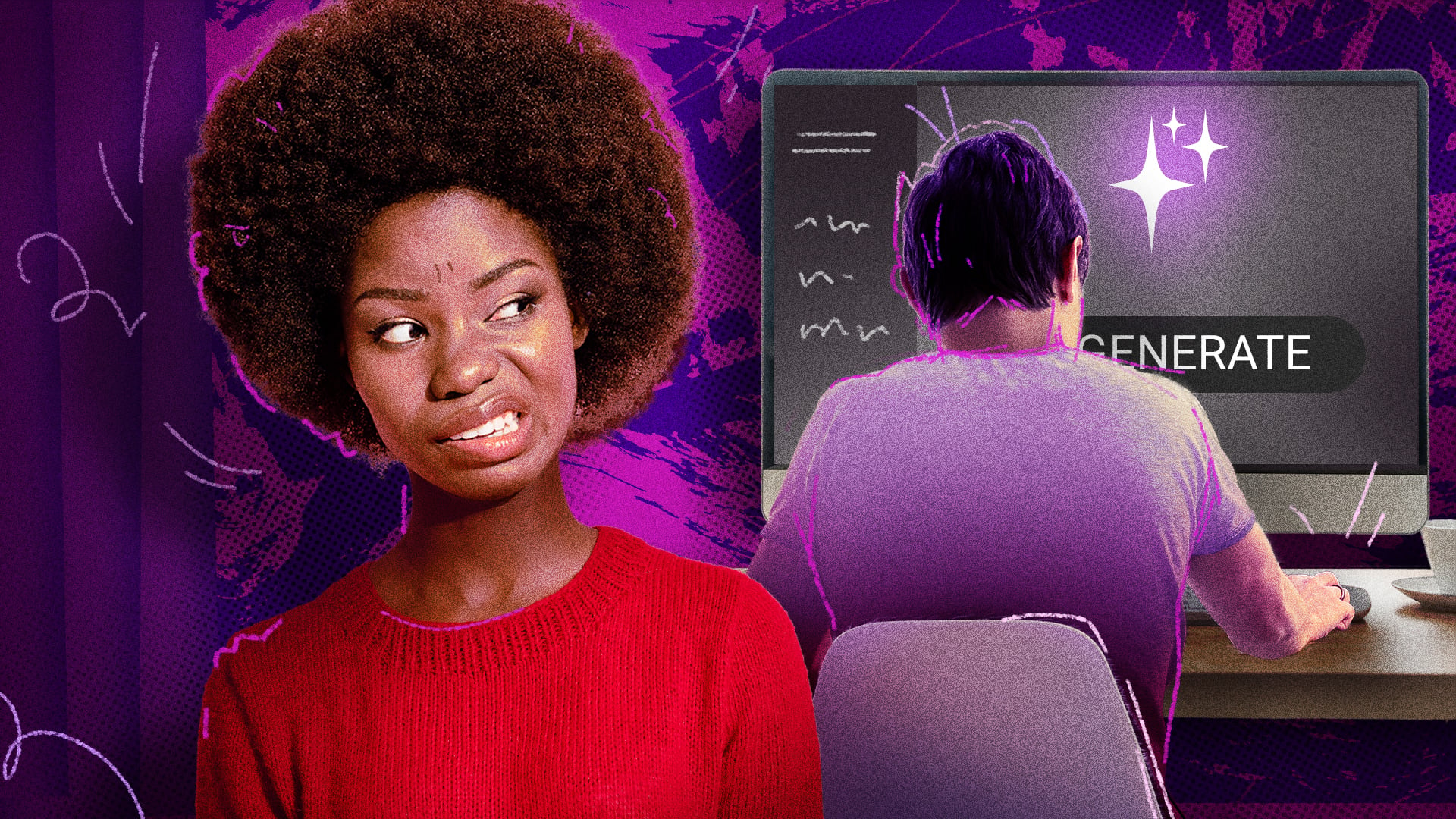
Beth, 27, had been on four dates with a man we’ll call Matt* when the pair passed a modern relationship milestone.
Matt followed Beth on Instagram. She followed him back. They continued to chat over WhatsApp and planned their next date.
But the next day, Beth spotted something alarming. On Matt’s Instagram stories, he had partaken in a trend to use generative AI to create a doll-like figure of himself, complete with themed accessories. Beth was immediately repulsed.
“It was cringe on multiple levels,” Beth told me in aghast tones over spicy margaritas in cans. “Firstly that he took part in a lame social media trend – and late, might I add – secondly that he thought the result was interesting enough to share, but mostly that he used AI to do it, and had no hesitation in admitting that. Bring back shame.”
“It was cringe on multiple levels.”
Beth went sleuthing through Matt’s grid and found that some of the captions – not all – had a whiff of AI about them. She scrolled back through their initial chats on Hinge and suddenly, all his charming lines seemed suspicious. “There weren’t em dashes or anything like that, but his opener felt off; it didn’t sound like him.”
She began to spiral. Just how much of their apparent connection had been forged by the likes of ChatGPT and Claude? Had he used AI to choose the specific pub they went to for date number two, which had been strangely central rather than in their respective locales of east and south London? Had he fed their conversations to a bot to craft a smooth response?
Along with that suspicion came another feeling, which Beth acknowledges could be seen as superficial: that AI is embarrassing, thus Matt was embarrassing, and she was significantly less attracted to him than she was before. She ghosted him.
Beth is far from alone in experiencing the AI ick. Many daters have negative views of AI use, according to research by Match Group, which owns dating apps including Tinder, Hinge, and OkCupid. Fifty one percent of women aged 18 to 24 say they would refuse to date someone who uses an AI companion app, per the research. Generally, studies point to negative feelings about AI outweighing positive emotions, so it’s little surprise that these sentiments are carrying over into our romantic relationships.
These negative views of AI are rubbing up against increased use of it for, well, everything, Ofcom research says more than half (54 percent) of UK adults use AI tools, and this jumps up to 79 percent among those aged 16-24 and 74 percent for 25-34s. The data suggests we’re using AI in increasingly personal areas of our lives. The most common use of generative AI in both 2026 and 2025 was therapy and companionship, according to 2026’s AI In The Wild report. The 7th most common use (out of 100 on the list) was “relationship advice,” per the findings.
AI isn’t only intruding in the early dating world. The AI ick is affecting long-term relationships, too – Wired journalist Alessandra Ram coined “the sad wives of AI” to describe the many women disgruntled by their partner’s overreliance on the tech. Men are more likely to use generative AI than women, so it’s unsurprising that when I asked people for stories of the AI ick, only women in heterosexual relationships reported experiencing the issue.
We haven’t yet seen a wave of AI-prompted divorces or ‘AI widows’, but couples’ therapists tell me they’ve heard clients mentioning AI’s impact, which can range from irritation to the consideration of a breakup. Amy*, 34, has been with her husband for eight years and doubts AI will result in their divorce, but she admits (anonymously) that she has concerns about her partner’s AI use.
“I worry how it’s impacting his critical thinking.”
“He uses it to help him make decisions – where to buy a used car, how to write a sternly worded email to the council, what smart shoes to buy for a wedding,” she explains. “I’d say he uses it weekly, sometimes more. I try not to judge him for it because I know so many people are doing the same, and nowadays thanks to AI overview, it’s not too dissimilar to plugging a question into Google. But I worry how it’s impacting his critical thinking; if Chat is making every decision for him (sometimes incorrectly – AI is rife with misinformation). Not to mention the impact it’s having on the job market and the environment.”
Amy has raised the topic with her husband, but says “he doesn’t see it as a problem”. It’s worth noting that Amy is not a total AI refusenik, having turned to it for advice with legal matters and tax, which does make her feel like “a bit of a hypocrite”. But even so, each time she learns her husband has used AI for something, the AI ick arrives – “to an extent you can get ‘the ick’ when you’re married!”
Similarly, Nara*’s boyfriend of three years, Sam*, has an “almost daily” AI habit that causes frustration, especially when he uses it to win arguments or prove her wrong. “I don’t like when he uses AI as a primary source of research on a topic,” says Nara. “It’s such a shallow way to understand something. What I find more frustrating is if I buy him a book on a topic, he won’t read the book but he’ll just use AI.” Asked what she would change in their relationship if he had a non-AI magic wand, Nara said: “Magically make him seek information from a variety of sources.”
While the AI ick in casual dating tends to be more about simply our perception of the type of person who uses AI, in more serious relationships it can emerge from a deeper hurt – that caused by a partner turning away from you and towards a third party, in this case AI. “If AI is used as an ally or as a kind of ammunition in an argument, this could be quite inflammatory,” says Joanna Harrison, a couples’ therapist and the author of Five Arguments All Couples (Need To) Have. “It leaves the other person feeling more defensive and less likely to engage. If AI is tending to be sycophantic, and making one person feel that their view is the ‘right’ one, then this is going to make them less curious in their partner’s point of view – and that’s what really matters, rather than who is right, that both people are interested in each other.”
AI can act as an unintentional wall in the middle of connection. People praise AI because it makes things easier and quicker, requiring less effort from the human. But in a relationship, effort goes a long way. We want our partners to try in order to show that they care. “Our intimate couple relationships are the place we long to be seen, to be understood, to be known in a special way,” Harrison continues. “Intimacy builds when a partner shows that they have understood something of us, or shows that they are really trying to understand who we are, as well as at the same time being open themselves to being seen and trying to express themselves. When AI is the substitute for this, the sense of a special intimate connection can be broken,” she adds.
“Take a present or a date planned and chosen by a partner’s imagination. There’s a sense of effort going into it, thought going into it, a kind of love ‘work’ that has gone on to try to curate something bespoke. If AI has chosen the gift or planned the evening, does it feel so intimate?”
Experts are united in their belief that the answer to the AI ick and the woes caused by it does not lie in pretending not to see the ghostly online presence in the room. Jane James, a couples’ therapist of 18 years, says: “Ignoring it is the worst thing to do.”
Instead, conversation is needed. And as soon as possible. “The more a habit, such as more tech use, becomes embedded, the harder it is to raise the subject and the more it feels like conflict or criticism,” James notes. “The topic needs to be identified and discussed early on. Talk about AI generally together. What are your opinions? Do you use it? What for? Do friends use it? Raise it as a subject like everything else.”
Agreeing on ground rules is wise, but these shouldn’t be a blanket ban on AI use. We’re aiming for compromise, not control. A boundary might be that AI shouldn’t be used during quality time together. Or conversely, you might agree that it can be used for relationship purposes as long as both partners are involved in the prompts. “Using AI together for planning, investigating, and research is an excellent idea,” suggests James. “Sharing what you find out and using the information for activities etc is positive and helpful.”
AI isn’t doomed to have a negative impact on your relationship – it’s all about how you use it. Harrison says: “If it helps a couple turn towards each other, not away from each other, and supports them to listen to each other more, and see each other’s perspective, then this could be a positive. If on the other hand it puts up a barrier between them or polarises them then I see it as something less helpful.”
Finally, if you’re the partner who’s using AI more frequently, be conscious of how it might shape how your partner sees you. Carolina*, 45, says that her ex’s excessive use of AI “may have cost the relationship”. They’ve broken up now but his AI posts give her the retroactive ick. Over the course of our conversation, she uses the following words to describe how his AI use makes her view him: “narcissistic, wanky, embarrassing, so fake, and so desperate.” Her ending note is simply to describe him as “so cringe”. Unless these are words you would like a partner to use to describe you, perhaps proceed with caution.
Critical thinking, an appreciation of human creativity, typos in place of perfection – these are things that have never been sexier.
*Names have been changed
Mashable