

Julian Shapiro-Barnum enters his late-night era
For years, Julian Shapiro-Barnum has built a career around helping others let their guard down. Whether he’s interviewing impossibly wise preschoolers on Recess Therapy or convincing celebrities to embrace the unexpected on Celebrity Substitute, his greatest talent has always been creating the kind of space where people stop performing and start playing.
Now, with his new YouTube late-night series Outside Tonight, Shapiro-Barnum is inviting audiences to see a different side of him, too — one that swears a little more, stays up a little later, and isn’t afraid to get weird.
How Sean Evans turned ‘Hot Ones’ into one of entertainment’s most important interview shows
The show swaps classrooms for New York City streets, children for comedians, creators, and strangers, but the philosophy remains the same: the best conversations happen when people feel free to be a little silly. It’s also his most ambitious project yet, arriving at a moment when digital creators are no longer waiting for Hollywood to catch up; they’re building the next generation of entertainment themselves.
In this edition of Creator Playbook, Shapiro-Barnum talks about reinventing late night for the internet, why play is the common thread running through all of his work, and what six years of building Outside Tonight taught him about growing up without losing his sense of wonder.
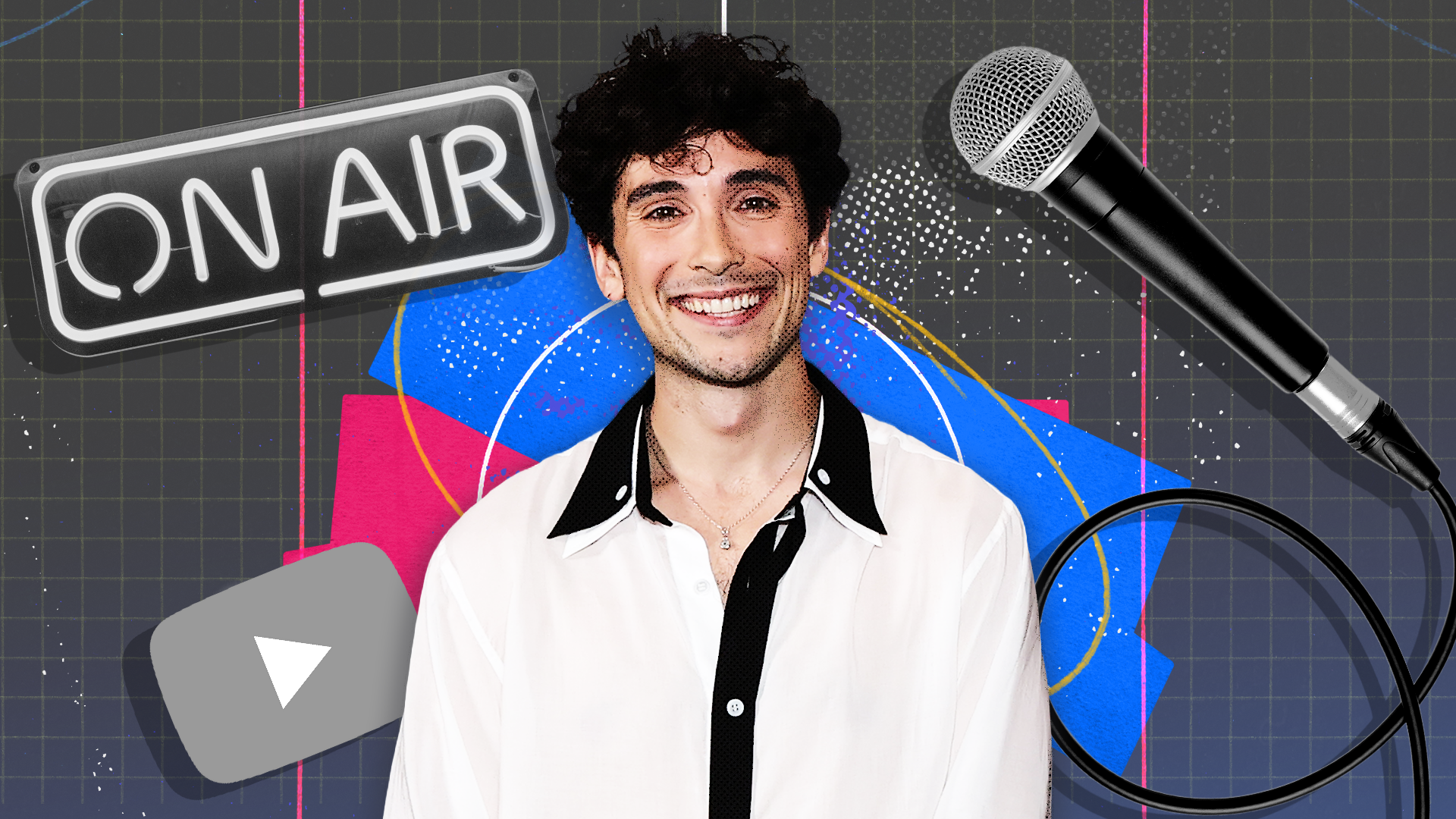
Credit: Cole Kan/Mashable/Getty Images for YouTube/Adobe
Mashable: It feels like creator-led entertainment has become the new “traditional media.” Outside Tonight, a late-night show made for YouTube, definitely feels like part of that shift. Have you felt it happening personally?
Julian Shapiro-Barnum: Oh, 100 percent. It’s kind of interesting because I started Recess Therapy five years ago, and that’s almost an older short-form show now. You see people like myself, Kareem Rahma, Sean Evans, Amelia Dimoldenberg — all these creators who’ve found success online — making bigger, more prestige-feeling digital shows instead of trying to leave the internet.
We’re seeing the industry take this space much more seriously. I don’t dream about the traditional entertainment industry the way I once did because everything I’ve always wanted to make, I can make now. I can self-produce it. YouTube is the perfect home for it. I already have an audience here, so I don’t have to wait in the same way anymore.
Do you think that’s what’s made creator-led entertainment so successful?
I think it’s kind of chicken and egg. The industry is finally catching up to what’s already been happening. I hosted the Golden Globes red carpet with two kids a couple of years ago, and at the time, it felt really crazy and out there. Now you see digital creators on every red carpet and at every major event. It’s become a staple.
People are pouring their artistic practice and their stories into YouTube, Instagram, and TikTok, and it’s exciting that we’re finally getting the support because it only allows us to go bigger. We were really scraping by for a long time, doing the best we could with very little. Now I’m able to make a late-night show. I don’t think I could’ve done this a couple of years ago. I tried, and it didn’t work. Now there’s finally the bandwidth to make something this ambitious.
Credit: Courtesy of YouTube
Let’s talk about that. You mentioned trying to make a late-night show before. What made you want to revisit the idea?
Maybe that was a little misleading. I started experimenting with the idea back in 2020, just for fun, but we really started developing Outside Tonight at the beginning of 2025. We partnered with a traditional production company that I won’t name. We worked together for about five months, and then, two months before we were supposed to launch, they basically told us, “Digital doesn’t seem like it’s for us.” It was devastating.
After that, we decided, “You know what? We’re just going to make it ourselves.” Looking back, I’m really glad it happened that way, because since last year, you’ve seen all the attention YouTube has gotten and the energy the platform has put into creator-led programming. It feels like an even more perfectly timed show now than it would’ve been then.
So, what is your version of late night?
I joke in the monologue that I’m changing late night by keeping it exactly the same. What I don’t think works about traditional late night isn’t really the format — it’s the distribution model around it. All the amazing people who make late-night special don’t actually own their own shows. They’re network shows, so there’s a lot of control over what gets made. Then there’s the way people actually watch them. To watch a full episode of Fallon, there’s a paywall. Most people are already consuming those shows through YouTube, TikTok, and Instagram. So why not make a show that’s built for a digital audience from the beginning?
We make a full episode for YouTube, but it also breaks down into a really modular format. The monologue is shorter, more bite-sized, and more information-driven. The interviews are much more conversational. They’re closer to what people love about podcast clips than traditional late-night interviews. The games are built around the kind of spontaneity that works online.
We’re basically taking everything that already works on the internet and reconstructing it into a late-night show. To me, the internet is a broken-down late-night show. We’re just sewing it back together now that we know it works.
Something else I’ve noticed is that comedians seem to be thriving on digital platforms right now. Everybody knows you from Recess Therapy, but you’re also a comedian. I’ve talked to people like Josh Johnson about this, too. Why do you think comedy translates so well online?
I don’t know if it’s just comedians. Maybe it’s less about stand-up specifically and more about spontaneity. Honestly, more than comedy clips, I think the podcast boom says a lot. People are hungry for that back-and-forth. They love banter. That’s why crowd-work clips take off. People want authenticity. They want to feel like something is unfolding in real-time.
That’s something we really embrace with Outside Tonight. Because we’re outside, the public becomes part of the show. I think that’s true of so many great digital shows. Subway Takes, SideTalk, Street Hearts — the New York creator scene is set outside because New York is already a studio. Outside Tonight leans into that. We’re bringing the public into the show.
Credit: Courtesy of YouTube
One thing that connects Recess Therapy, Celebrity Substitute, and now Outside Tonight is that people seem to let their guard down around you. What’s the common thread?
I think the common thread between all my projects is play. With kids, I try to make them feel comfortable enough to come out of their shell and have a real conversation. With Celebrity Substitute, I wanted celebrities to do something they’d never done before. And with Outside Tonight, it’s about asking adults to drop the mask, be really silly with me, and play. One of the things I love about late night is that it’s on after you’re supposed to be asleep. It feels like you’re getting away with something. Outside Tonight has that same energy. We’re outside, we’re in a park, we’re being a little provocative. It’s a very playful show.
That’s interesting because one thing I wanted to ask was whether, after working with so many children, there’s a part of youth you’ve become protective of.
Yeah, definitely that sense of play. I’m a very playful, goofy guy. I take my work very seriously, but I’m not a very serious person. Even in the first episode, I’m talking to elderly people about sex in this really playful way, and they’re talking about how you’re never too old for different experiences. I’m kind of against the idea that people age out of certain behaviors.
That’s actually what my book is about. It’s called How to Grow Up Without Becoming a Grown-Up, and it’s a collection of essays about growing up without losing your childishness. That’s something I hold really near and dear.
What about your interview style? There’s been a lot of conversation recently about creators who interview people. Are they journalists? Are they conversationalists? How much of your approach is instinct versus preparation?
I go into every interview with a plan, but I’m a comedy improviser, so I follow the fun. I have a backbone, a spine that I stick to, but if something makes me curious, I want to follow it.
With kids, that’s easy because they’re never going to stay on topic anyway. Nothing I bring in is going to work exactly the way I planned. Adults are actually harder because they’ll answer the question and then sit back and wait for the next one. I think my interview style is first thought, best thought, bolstered by good questions.
Credit: Courtesy of YouTube
After talking to thousands of kids at this point, have they made you more optimistic or more realistic about the future?
That’s an interesting question. Honestly, I think kids make me more optimistic because the kids I’m around are really hopeful. They genuinely believe they can make the world a better place.
My hope is that every generation hangs onto that optimism a little longer than the one before it. We’re living in a pretty pessimistic moment right now, so spending time with kids reminds me that the kids are all right, so to speak.
After all those conversations, what’s one thing kids consistently understand better than adults?
Kids are brilliant at honoring their emotions. Adults are fantastic at saying, “I don’t want to deal with this right now. I’ll deal with it later.” Kids have tantrums. They tell you when they don’t like something. I’m not saying adults should throw tantrums, but I do think there’s something to be learned from processing your feelings in real-time rather than judging or burying them.
One thing I’ve always been curious about is whether there was a moment when you realized, “Oh, I’m a brand now.”
That’s funny. I don’t really feel like a brand until something feels off-brand. I actually had to think about that with Outside Tonight. Up until now, I think people knew me as the really friendly, clean-cut kid guy. This show pushed me to test those boundaries a little. I’ve posted some pretty ridiculous, provocative things over the past couple of months to promote it.
In doing that, I had to figure out what my brand actually is. To me, it’s being positive, people-forward, and friendly. But that doesn’t mean I can’t also be provocative, goofy, or silly in a more adult way. I try to bring the same energy I have with kids to adults. It just has a different flavor. Making this show forced me to learn more about myself. I never really thought about my brand until I had to expand it.
That’s interesting because, early on, a lot of people compared you to Mister Rogers.
Yeah, and I’m kind of breaking out of that without rejecting it. That comparison is genuine — it is me — but I think people are realizing there are a lot more colors and shades to that person than they originally thought.
It’s almost like your own coming-of-age story.
Exactly. I’m having my “Wrecking Ball” moment.
Lastly, what are you most excited for people to see when they watch Outside Tonight?
Honestly, I just hope people watch it. This is a project I’ve been working on for six years. I’ve put my entire heart and soul into it, and I really hope people connect with it. It’s on YouTube.
Six years is a long journey. I think that’s encouraging for creators, too. Sometimes the ideas you care about the most take time.
Totally. If you believe in something and keep working at it, it can happen.
You only have to go viral a couple of times.
[Laughs.] Yeah. You only need a couple billion impressions.
Mashable