October
01



The End of Oak Street ending explainer: Wait, what? How? When?
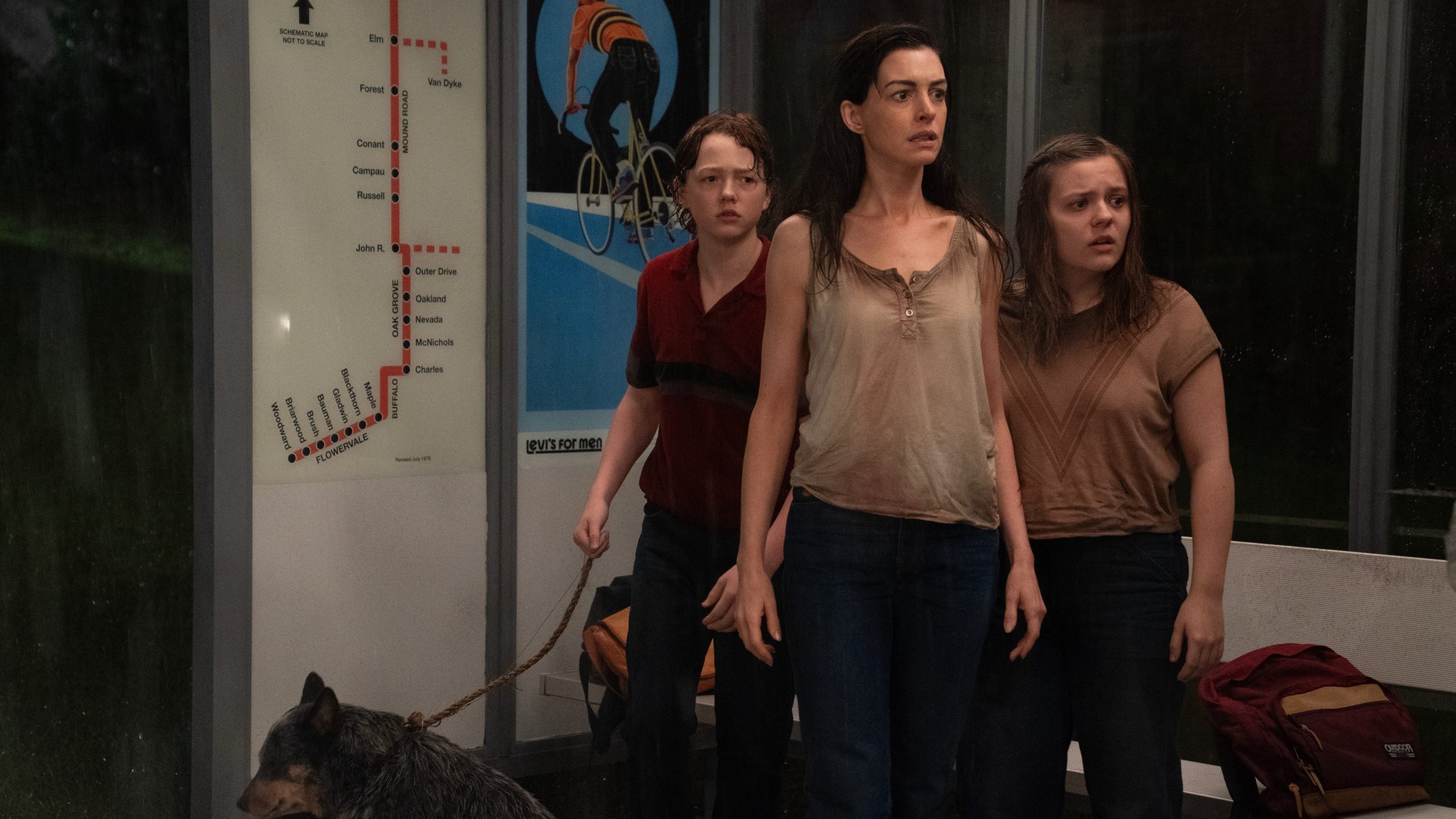
Written and directed by David Robert Mitchell, The End of Oak Street plays like a twisted reimagining of Steven Spielberg’s Jurassic Park. The suburban Platt family is having an average summer of block parties, parental bickering, and unrequited crushes when time travel upends their lives.
Dinosaurs now prowl their streets, tower over their homes, and descend from the skies. Neighbors are turned into bloody remains, bedecking their yards like grisly lawn ornaments.
And then comes that ending. Whether or not you liked The End of Oak Street for Mitchell’s gruesome kills, slasher-style scares, or bewilderingly bad dialogue, you might well be scratching your head over that ending.
So, let’s get into it.
How does the time travel in The End of Oak Street work?
Credit: Warner Bros. Pictures
In the film’s first act, set in 1982, there’s a news broadcast about NASA researching temporal anomalies. But the Platt family is so caught up in their domestic drama, they don’t take note.
The first family member to get a hint of what’s to come is mother Denise (Anne Hathaway). When visiting her friend, the widow Mrs. Huddleston (Anne Gee Byrd), Denise is shown a strange plant that’s come up inexplicably fast in Mrs. Huddleston’s backyard. A subsequent research trip to the library garners little information in the books of contemporary flora. But librarian Mrs. Valcourt (Emily Kuroda) is able to look at Denise’s Polaroid of the plant and instantly identify it as being from 200 million years ago.
Later come the flashing lights, noticed by adolescent Brian (Christian Convery) and his rambunctious dog, Starbuck, while Denise was working on her Erica Jong-like novel. These lights, as Brian’s Carl Sagan-obsessed sister Audrey (Maisy Stella) will later posit, are effectively wormholes to another time. So, when the big flashing light sounds after father Greg (Ewan McGregor) gets back from his pizza deliveries, two miles of Flowervale are transported back to an age when dinosaurs ruled.
In this setting, the Platts must fight for survival against an array of prehistoric creatures that are all too happy to make them a family meal. But when Denise and Greg discover a large, shiny orb in a neighbor’s house, they believe it’s a portal back to their time, as they can see contemporary houses within it. Now, it’s just a matter of making it to such a portal with their whole family before it disappears.
How does The End of Oak Street end?
Credit: Warner Bros. Pictures
After Greg is eaten by a T. rex, Denise, her children, and orphaned neighbor girl Jeannette (Jordan Alexa Davis) head to the home of the aforementioned librarian, because there’s a possible portal floating near her roof. A shattered window suggests Mrs. Valcourt has already had some unwelcome company. And indeed, Denise and the kids soon encounter some crocodile-like dinos eating what was presumably Mr. Valcourt.
After much Scooby-Dooing around the second-floor hallway, Mrs. Valcourt gives her life to save the Platts from the dinos. Then, Denise, the kids, and the family dog leap through the portal and find themselves in a cement swimming pool. An understandably annoyed woman chides them for being in her pool, and then tells them the date is July 11, 1982. This is the same day their neighborhood was swallowed by a portal, but about twenty minutes before it will happen again. Jeannette runs off to warn her parents.
The surviving Platts look down on the doomed Oak Street, and Audrey wonders aloud if there are doubles of them down there, in their house. Unspoken is that Greg is still alive here.
The Platts fret about what they can do in such a short time to save others. Denise tells the kids to go to the hills, where the portal won’t reach. She has phone calls to make.
While Mitchell’s script doesn’t let us in on those calls, the film’s resolution will make clear who was on the other end. From there, the Platts sit at a bus stop and wait. For what? The arrival of a familiar vehicle with a Pete’s Pizza topper. To bring Greg to them, Denise orders a pizza, calling him up to the hills where he’d be safe from the portal’s arrival.
The family embraces, and The End of Oak Street cuts to a year later.
News reports detail how the neighborhood was swapped for one from millions of years before. But the authorities captured or killed the dinosaurs who appeared in 1982. As for the human residents of Oak Street, several of them give on-camera testimonials championing Denise’s heroic actions. Mrs. Huddleston, Mrs. Valcourt, and the Platts’ ornery next-door neighbor, Mel Jacobs (P.J. Byrne), were all saved, because they listened when Denise’s phone calls told them to get out.
As for Denise, her book about her unhappy marriage was lost to time and a flooded basement. But her time in the past led to her penning a new book called The End of Oak Street.
Does the ending of The End of Oak Street create a time paradox?
Credit: Warner Bros. Pictures
Mitchell’s movie does not lay out the specifics of its time travel. Is it a time loop? Does it establish with its final act an alternate timeline? Within the film itself, it’s unclear. But here’s our best estimation.
The Platt family traveled back in time, and returned home through their joint efforts to survive. By calling Greg to them in the hills, Denise saves him from becoming T. rex food. However, she also dooms a version of herself and her kids to dino land without Greg.
And without her husband’s intervention, Denise would likely have been eaten by the T. rex. So, did Denise doom another version of herself to death? Specifically, a version of herself that sought freedom over her family? It’s a pretty intense way for Mitchell to make a family-first argument. But beyond that, is it even possible the Platts could survive without Denise? At the first sign of trouble, Greg’s go-to is hidden whiskey and goofy dad jokes. His plan was to stay put in their house until the town blipped back. But in the film’s finale, a year has passed and no such return blip has brought the houses back. So, even if they could have survived a year, that wouldn’t have been a solution.
Beyond that, if post-dino fight Denise prevents pre-dino fight Greg from going back in time, then the path to her and the kids getting back to the future wouldn’t happen. That would be a time paradox. However, The End of Oak Street may not be a time-loop movie. Perhaps Denise created an alternate timeline and pulled Greg successfully into that. If this is the case, The End of Oak Street offers a happy ending that’s still bizarrely dark.
The final sequence shows Denise walking through her home, where framed photos hang of the family smiling, Brian with a girlfriend who probably doesn’t prefer his sister, and the Polaroid of the Greg who did die, posing before some rutting brontosauruses. As Denise meets her family in the yard, they’re joined by Jeannette and her parents. A family barbecue! What could be more indicative of an American happy ending?
Except, what did Greg make of all this information? The photo being framed in the home and Denise’s book suggest he was told about what happened to him (or a version of him). He’s not the man who risked his life to save his wife, but now he is her husband. Does he have any guilt for moving on with post-dino fight Denise while the family he knew is doomed to die in the past? Is Denise haunted by the choice to leave a version of her kids to be thrust into the prehistoric hell with which she is all too familiar? Are her children going to be able to form meaningful long-term relationships when they watched their parents bicker, their father die, and their mother replace him with the ring of a phone?
The End of Oak Street won’t grapple with any of these possibilities.
Focus on the barbecue, it beckons, leaving audiences with a flimsy happy ending that hearkens back to the likes of 1956’s The Bad Seed and Invasion of the Body Snatchers. All three movies offer a resolution that entreats: Forget the horrors you’ve seen! The child killer is ruthless, but she’s been smote by lightning! The pod people are among us, but surely the U.S. government will stop them… somehow.
These 1950s movies aimed to coddle the audience with an ending that wouldn’t leave them scared. In the case of The Bad Seed, they even added a curtain call, where the child actress is playfully spanked by her onscreen mother to give the audience assurance that the horrors of the film shouldn’t follow them home. And perhaps we harbor a crooked sentimentality for these endings, because we like to think art and audiences have moved past such clumsy compromises. These endings certainly don’t fit, as they seem ludicrously life-affirming and abrupt after so much horror. But it’s 70 years later, and studios are still spoon-feeding us such senselessly happy endings, as if we can’t recognize how pandering and preposterous they are. It’s not charming now; it’s infuriating slop.
The End of Oak Street is now in theaters.
Mashable