


Bright planets can blind the Webb telescope. A fix is coming.
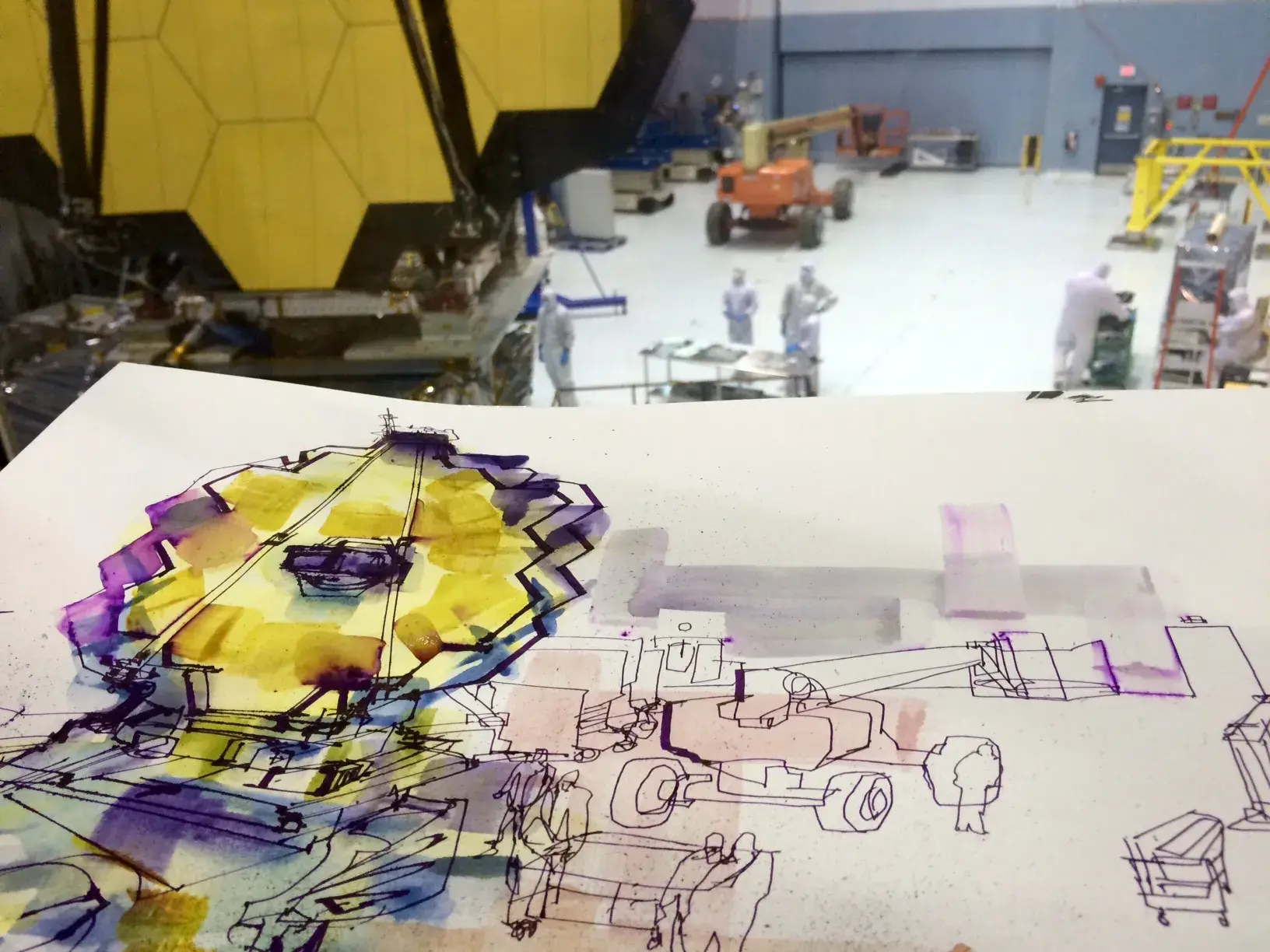
When Nobel Laureate John C. Mather used to give talks about the James Webb Space Telescope, he would often use an impressive analogy — that the observatory was so sensitive, it could detect the heat of a bumblebee as far away as the moon.
That’s because Webb, a collaboration of NASA and the European and Canadian space agencies, was built to detect the faintest, most ancient light in the universe — galaxies and stars that formed just a few hundred million years after the Big Bang.
But there’s an irony to having the world’s most powerful infrared telescope in space: While Webb is exceptional at seeing unfathomably distant things, it struggles to take pictures of objects in our own cosmic backyard, like Mars and Saturn.
Because the planets in our solar system are so bright, they flood the telescope’s sensors with more light than they can handle. To get these shots, astronomers have had to use dark filters — akin to wearing solar eclipse glasses — to avoid blinding the camera.
Now, telescope operators have a workaround, and it doesn’t require astronauts visiting the spacecraft a million miles away for maintenance. Instead, engineers are sending a software update from the ground that will let Webb photograph bright planets without throwing away useful data.
The new readout method, called “superstripe,” should allow Webb to safely photograph targets that are 100 or more times brighter than it could handle before, said Bryan Holler, a scientist at the Space Telescope Science Institute in Baltimore.
Even Holler, who took Jupiter photos with Webb in 2022, admits those first images were a blurry mess. That’s because the camera took several seconds to read the whole image while the planet’s fast‑moving clouds shifted. Those test images were intended to assess how much unwanted stray light Webb would see as Jupiter moved onto the camera detector.
Early images of Jupiter and its moon Europa were blurry and overexposed, highlighting the James Webb Space Telescope’s challenges taking images of bright solar system objects.
Credit: NASA / ESA / CSA / B. Holler / J. Stansberry
Credit: NASA / ESA / CSA / B. Holler / J. Stansberry
Webb later produced more photogenic Jupiter images by using shorter exposures and more selective settings.
“The nicer Jupiter images that are out there from people who really know how to do image processing, they were able to actually deblur some of those images using the data,” Holler told Mashable.
But sharpening software can’t rescue light that was never recorded in the first place. Until now, scientists have tried to solve the problem by cropping the camera’s view down to a tiny box to limit the incoming light. The new superstripe technique is an upgrade: Instead of taking one picture, the camera scans the planet in thin slices, stealing many rapid glances.
Because the camera captures each individual slice in a fraction of a second, it doesn’t get dazzled by the glare. Plus, the quick snaps mean there’s little time for changes in extraterrestrial storms or auroras to blur the shot. Afterward, the software stitches the slices together into a single crisp picture.
Although Webb wasn’t built to look at our solar system, many astronomers are eager to use it to study nearby worlds anyway. Webb’s biggest advantage is its location: It can look out into the cosmos without Earth’s air getting in the way.
Credit: NASA / ESA / CSA / Ricardo Hueso / Imke de Pater / Thierry Fouchet / Leigh Fletcher / Michael Wong / Joseph DePasquale
“A lot of that tends to come back to this pesky atmosphere,” Holler said. “It’s fine for breathing and everything, but when you really want to study surfaces or atmospheres, you have to leave [our] atmosphere.”
Even giant telescopes on the ground have trouble seeing through Earth’s blanket of air, which absorbs certain types of light before they can reach the telescopes’ lenses.
Researchers say this new software could open the door to new discoveries. The stripe-style camera trick could catch rare moments, like when a giant planet, one of its moons, or even its rings briefly block a background star, giving scientists cleaner measurements of their sizes and atmospheres.
It will also allow astronomers to observe exoplanets orbiting ultra-bright stars outside our solar system, such as 55 Cancri e, a scorching-hot lava world 41 light-years away.
The superstripe readout capability is scheduled to roll out with Webb’s next observing cycle, which begins next July. For the rest of us, just sit back and relax: Sharper views of our own cosmic neighbors are on the way.
Mashable