

One strange Voyager 1 mystery persists as it moves beyond a light-day
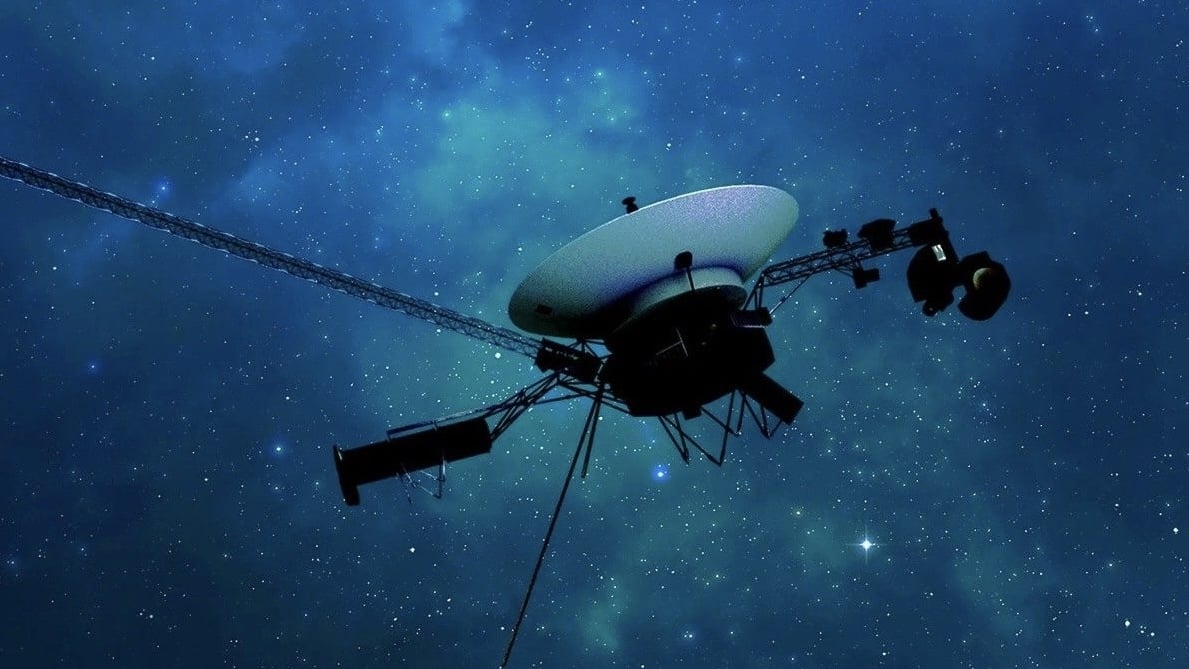
NASA‘s Voyager 1 is tracking a deep-space mystery that has stumped scientists for the past six years.
In 2020, about eight years after leaving the solar system, the spacecraft flew into a region where the magnetic field rose like an incoming tide. Earlier events had spiked and then faded, like waves breaking on a beach. But this tide never went out. Even today, it still hasn’t receded.
The sun constantly streams out charged gas and magnetism, called solar wind. That stream blows a giant bubble around the solar system, which scientists refer to as the heliosphere. Voyager 1 exited the bubble in 2012, and its twin, Voyager 2, taking a different route, left in 2018. Both now travel through interstellar space, the thin mix of gas, magnetism, and fast-moving particles between star systems.
Voyager 1, which left Earth in 1977, will reach one light-day, the distance light travels in 24 hours, or about 16 billion miles, on Wednesday, Nov. 18. That historic milestone makes the aging probe irreplaceable. No other spacecraft has explored this far beyond the sun’s bubble. Every reading Voyager 1 sends home adds to the only direct measurements anyone has of the space environment between the sun and other stars.
That data has already taught scientists something fundamental about our home in space. Once outside the bubble, the Voyagers recorded a sharp jump in cosmic rays, the high-speed particles that supernova explosions fling across the galaxy. The readings showed that the bubble blocks roughly 75 to 85 percent of that radiation, depending on how active the sun is.
“We see how much the sun and this astrosphere all around us, known as the heliosphere, protects us,” said Jamie Rankin, Voyager’s deputy project scientist and a research scholar at Princeton University, during a NASA webinar last November. “It’s pretty incredible, and it’s a good question to ask: Without our heliosphere, would life exist?”
Beyond the bubble, Voyager 1 found four bumps in the magnetic field between 2012 and 2020. The magnetic field is the invisible magnetism that fills space. A 2021 study, published in The Astrophysical Journal, identified two of the bumps as sharp shock waves, a bit like sonic booms. The other two were gentler, broader swells that scientists call pressure fronts.
The earlier pressure front in 2016 took about 400 days to die down. But the latest swell, known as “pressure front 2,” is still going. Voyager 1 hit it in when it was about 149 times farther from the sun than Earth. In just eight days, the magnetic field increased by about one-third. That continues to be the strangest thing Voyager 1 has seen beyond the bubble, Rankin says.
Want more science and tech news delivered straight to your inbox? Sign up for Mashable’s Top Stories newsletter today.
Effects from the sun usually die out within a few months, Linda Spilker, Voyager’s project scientist at NASA’s Jet Propulsion Laboratory, told Mashable.
“It might be an effect coming from interstellar space,” Spilker said in an email. “Voyager 1 continues to observe this phenomenon, and scientists hope to see what happens if it ends, one good reason to keep Voyager 1 flying.”
Computer simulations offer little help for solving the mystery. The 2021 study found that none of the leading models could reproduce the mix of shocks, swells, and placid stretches that Voyager 1 encountered.
Credit: NASA infographic
Figuring it out could show how far the sun’s influence truly extends, even outside the bubble. The 2021 study traced the earlier events to ripples that form when big bursts from the sun slam into the edge of the heliosphere and then roll outward.
But the clock is ticking. Each Voyager runs on a nuclear battery that loses about 4 watts of power a year. That has forced the team to switch off some instruments in order to conserve energy. The spacecraft still run instruments that measure magnetism, radio signals, and cosmic rays. Scientists need those tools to keep monitoring the pressure front.
If Voyager 1 holds on long enough, it may see how and where the mysterious pressure front ends.
“For a while, it was kind of unknown what would the Voyagers be doing after they turned off their cameras, because that was kind of like the end of the planetary science phase of the mission,” Rankin said. “But it turned out that the original people operating the spacecraft, they were visionaries, and they wanted to see where these boundaries lie.”
Mashable