
Everything about BepiColombo entering Mercury orbit on Saturday
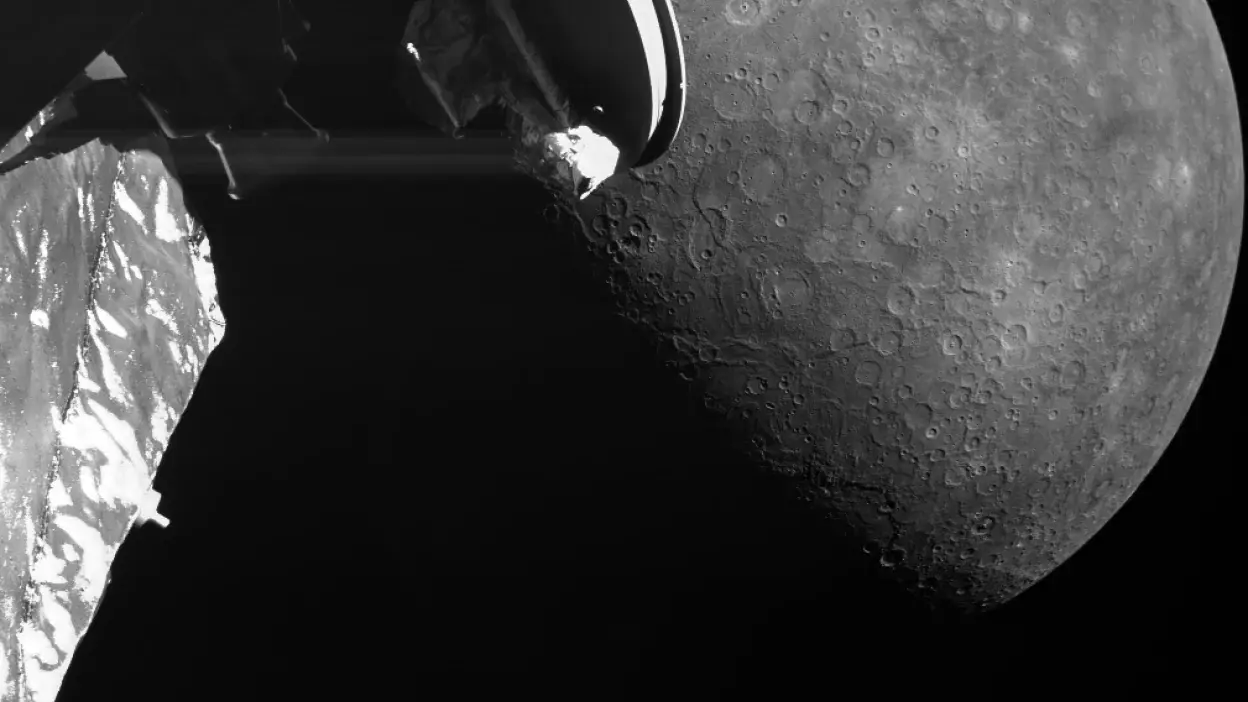
A robotic spacecraft that has spent eight years looping around the inner solar system is finally set to lock into orbit around Mercury, the planet closest to the sun.
The European-Japanese mission, called BepiColombo, carries two science probes stacked on top of each other. One is the European Space Agency’s Mercury Planetary Orbiter, or MPO. The other is Japan Aerospace Exploration Agency’s Mercury Magnetospheric Orbiter, nicknamed Mio.
A big engine burn should steer the pair into a regular, closed orbit that passes over the planet’s north and south poles on Saturday, Nov. 21.
Mercury is the least explored planet in the inner solar system. Only two spacecraft have ever visited it, NASA‘s Mariner 10 in the 1970s and Messenger in the 2010s. That will make BepiColombo just the second mission to orbit Mercury and the first to put two orbiters there at once. One probe will observe the planet itself and the other will study its space environment. Scientists hope the results will show how rocky planets like Earth form and change when they’re born close to their star.
Reaching Mercury is actually harder than getting to Pluto. Falling toward the sun isn’t the only problem. It’s bleeding off enough energy to avoid overshooting the planet.
BepiColombo launched on Oct. 20, 2018, on an Ariane 5 rocket from Kourou, French Guiana. For most of the trip, it rode on a separate engine module that used ion thrusters. These engines push the spacecraft by firing charged particles out the back. The force was about as strong as the weight of two sheets of paper resting on your hand. But the thrusters ran for two years, carrying the spacecraft about 6 billion miles.
Credit: ESA / ATG Europe infographic
The spacecraft also used gravity from nearby planets to bend its path. It swung past Earth once, Venus twice, and Mercury six times. In Sep. 2024, it passed within about 100 miles of Mercury, the closest any spacecraft has ever flown past a planet. The trip wasn’t smooth sailing. The engine module’s solar panels started losing power, so the team had to slow down and push back the arrival date. Controllers detached the engine module on Sep. 3.
“It’s a very difficult mission and very challenging because we are flying into a very, very harsh environment,” Bruno Sousa, ESA’s head of operations definition and engineering, said during a livestream that day. Mercury’s surface can drop below -290 degrees Fahrenheit at night and climb above 750 degrees during the day. The spacecraft gets baked from two sides — by sunlight and heat rising off the planet.
The arrival itself is unusual. Most missions hit the brakes hard and drop straight into orbit. BepiColombo is coming in slowly instead, and it gets there in steps. First, it drifts into Mercury’s gravitational grip on a loose, irregular path that doesn’t loop all the way around the planet. Engineers call this “weak capture.” Spacecraft operations manager Ignacio “Nacho” Clérigo said no one has tried it with a planet before, only with moons. Saturday’s big burn swaps that wandering path for a true orbit. It starts out as a long, lopsided oval, and the spacecraft fires its engines about every three days to reel it in.
Want more science and tech news delivered straight to your inbox? Sign up for Mashable’s Light Speed newsletter or get Mashable push alerts today.
As the orbit tightens, a series of handoffs follow. On Dec. 9 and 10, the European orbiter releases Mio into its final orbit. Full science work should begin in April 2027.
Mercury holds plenty of puzzles. It’s unusually heavy for its size. Apart from Earth, it’s the only rocky planet with a magnetic field surrounding the whole planet. Scientists want to learn whether Mercury’s huge liquid core has a solid center. Others plan to measure magnesium, potassium, and calcium in the space around Mercury. Those elements offer indirect clues about what the surface is made of.
The mission is named for Italian mathematician and engineer Giuseppe “Bepi” Colombo. His work on using planets’ gravity to steer spacecraft helped make the earlier Mercury missions possible as well as BepiColombo’s long, looping route.
Mashable