


Can a $250 alarm clock break my doomscrolling habit? I slept next to the Dreamie for a month to find out.
For years, my nighttime routine has involved a lengthy social media binge. It always starts as “one last scroll” as a way to decompress, before sliding into a mindless midnight swiping spree. I’ve spent many a night looking like that one Sarah Paulson meme, face glowing in the dark as my brain slurps up an endless feed of viral chum.
I know I’m not alone: Doomscrolling is practically a national pastime in 2026. Studies indicate that anywhere from 31 to 64 percent of U.S. adults do it regularly. And with over half of us bringing our phones to bed every night, doomscrolling is often linked to sleep disturbances, among other physical and mental symptoms.
At the Consumer Electronics Show in January, a tricked-out smart alarm clock called the Ambient Dreamie was pitched to me as a doomscrolling habit-breaker. Ambient CEO and co-founder Adrian Canoso told me he came up with the idea for the device several years ago amid a stretch of insomnia, wanting a sleep device that cut out his phone as he tried to wind down at bedtime. This isn’t a revolutionary idea, but unlike popular alternatives, the Dreamie doesn’t rely on a separate app or subscription. It’s a truly phone-free bedside companion.
The catch is that the Dreamie isn’t cheap: Ambient sells it online for $249.99 a pop. (The code SLEEPWELL will save you $25 during Sleep Week through March 14.) I’ve spent the past month snoozing next to one to find out if it’s actually worth the money.
How the Dreamie works
Credit: Haley Henschel / Mashable
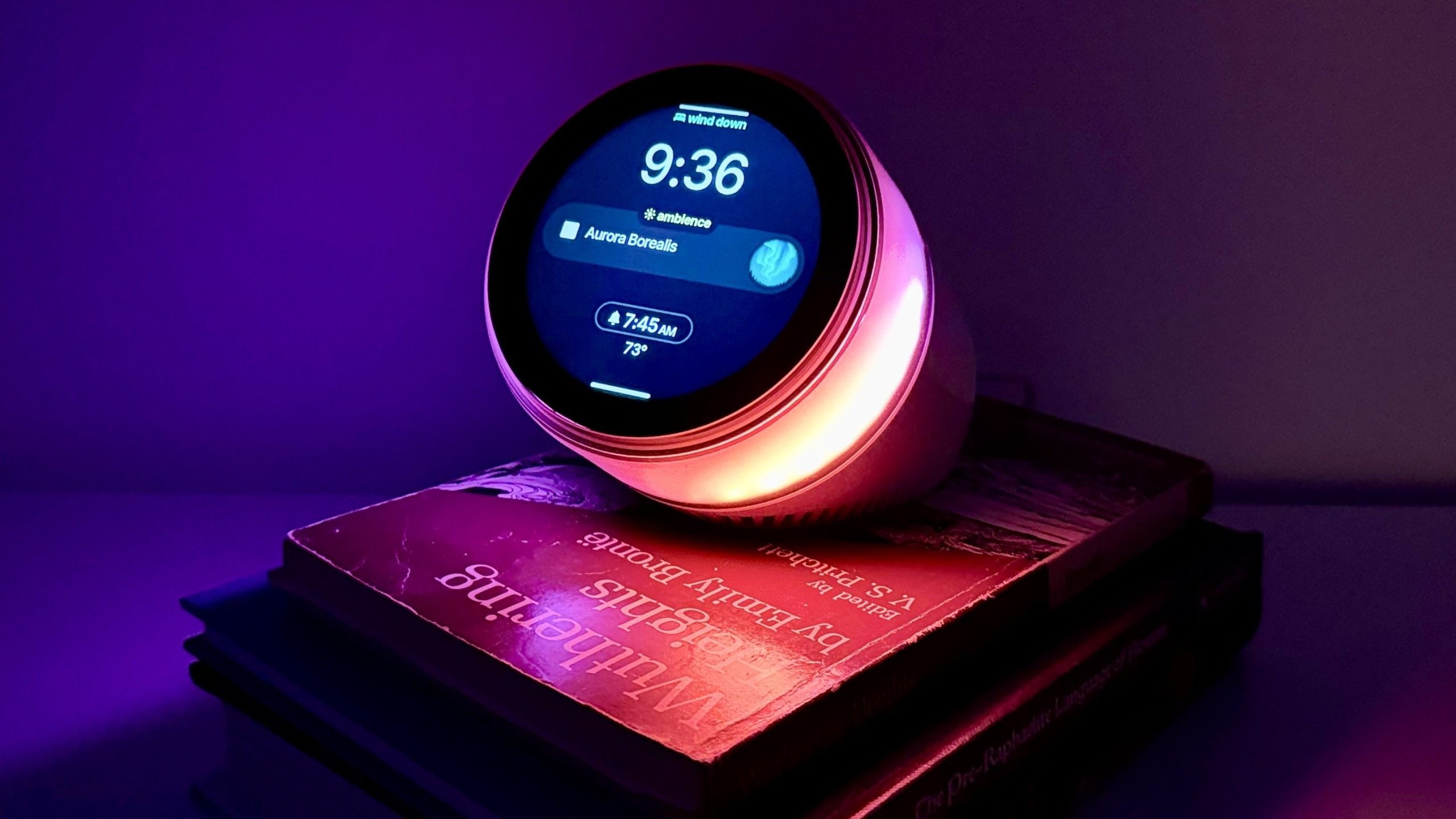
The Dreamie is a white pill-shaped gadget with a modern, inconspicuous look and no external branding. It has a circular display with a clock face, adaptive brightness, and touchscreen controls that are easy to navigate in a daze. The Dreamie needs to be hooked up to your home’s WiFi so it can download software updates, but you can’t use it to check notifications or access the web. It’s corded, so you don’t need to worry about recharging any batteries.
A warm light ring surrounding the Dreamie’s screen supports dynamic RGB effects. You can dim it by swiping your finger along a touch strip on top of the device. Doing so produces a dot in the middle of the Dreamie’s screen, which you can drag around to point the light in any one direction — helpful for finding things in the dark.
Credit: Haley Henschel / Mashable
Twisting the Dreamie’s light ring changes the volume of its built-in 360-degree speaker. (It gets impressively loud, so I never used it over the halfway mark.) The device comes pre-loaded with an audio library of 15 different sleep “scenes,” some of which are paired with lighting effects for extra ambiance. “Fireplace,” which sounds like softly crackling logs, makes the light ring flicker in shades of orange, while “Aurora Borealis” sets off a synthy soundscape with rainbow waves. There are environmental sounds, guided breathwork exercises, and green, pink, and brown noise options.
Credit: Haley Henschel / Mashable
The Dreamie has Bluetooth support, so you can use it with the best sleep earbuds if your bedmate likes to slumber in silence.
When you boot up the Dreamie for the first time, it’ll prompt you to reflect on your recent sleep cycles and set some sleep goals. For example, I’m trying to get eight hours of sleep and wake up by 7:45 a.m. every weekday. The Dreamie suggests an ideal bedtime based on these metrics (i.e., basic math).
Credit: Haley Henschel / Mashable
From there, you can customize your “sleep routine” with different audio and lighting scenes. The Dreamie divides this routine into three phases, which begin automatically around your bedtime. You can change or omit any of them based on your preferences:
Your Bedtime Cue scene tells you when you’re supposed to start getting ready to sleep
Your Wind Down scene helps you fall asleep
Your Noise Mask scene keeps you asleep
You can also program a “wake-up schedule” of alarms throughout the week. You’re free to add as many schedules as you’d like and modify them with four different alarm sounds, a gradually intensifying “sunrise” lighting feature, and snooze timers.
Credit: Haley Henschel / Mashable
Swiping down on the Dreamie’s clock face will manually cycle between Wind Down, Noise Mask, and a static “Ambiance” scene. Swiping up reveals a menu with other settings, including:
Different clock face designs
An option to hide the clock when the Dreamie is idle
A simplified dark theme for nighttime
A room temperature reading
A redshift mode with reduced blue light
A “Back to Sleep” scene to play if you wake up in the middle of the night
Hands-on with the Dreamie: What makes it special?
Credit: Haley Henschel / Mashable
The Dreamie makes it easy to pretend like your phone doesn’t exist. It doesn’t require an app for setup, and it eliminates most excuses for bringing your phone to bed by offloading your alarms, night lighting, and sleep content.
Admittedly, my doomscroll-addicted brain did not love this concept initially. My mind was racing and antsy the first few times I climbed into bed without its favorite self-soothing toy, looking for something to do.
The Dreamie’s scenes were actually really helpful in quieting these thoughts. They fill the void of silence, so it’s harder to get distracted by musings of work or every mistake I’ve ever made. I’ve started relaxing and falling asleep much faster than usual. I slept in complete silence before this, so consider me converted.
I like using the “Wave Breathwork” and “Light Rain” scenes for my Wind Down and Noise Mask phases, respectively. (That’s so Scorpio of me.) I’m a night owl who’s been bad at keeping regular bedtimes since college, when I worked for a student newspaper with a 2 a.m. print deadline, so I normally skip Bedtime Cue entirely. But when I do use it, I pick “Fireplace” for the cozy vibe.
Credit: Haley Henschel / Mashable
Mornings are also dramatically better with the Dreamie. For my daily wake-up schedule, I use its default “Bells” alarm sound with a 10-minute sunrise simulation. The sunrise effect is too weak to wake me up on its own (even after a recent update that made the Dreamie’s light ring brighter), but Bells has been a very pleasant change from my usual harsh iPhone alarm. Waking up isn’t a jump-scare anymore. And I no longer instinctually reach for my phone first thing — a freeing feeling.
While Dreamie is expensive, it’s a one-time purchase. Other popular smart alarm clocks like the Hatch Restore 3 and the Loftie Clock are cheaper upfront (both retail for $170), but some of their features are locked behind $50 annual subscriptions. The Dreamie undercuts them after less than two years of use.
Credit: Haley Henschel / Mashable
Not only is the Dreamie subscription-free, but you don’t even have to create an account to use it. It’ll never ask you for your name or email address.
Notably, the Dreamie has Platinum Certification from the Calm Tech Institute, a research firm focused on mindful tech design. According to a CTI blog post, it’s “the first bedside device to earn recognition for successfully minimizing bedroom phone usage while respecting human attention and privacy” based on an 81-point rating system.
Want to learn more about getting the best out of your tech? Sign up for Mashable’s Top Stories and Deals newsletters today.
More Dreamie features to look forward to
Credit: Haley Henschel / Mashable
So, is the Dreamie worth the investment? I would say yes under two circumstances: if you plan on using it long-term, and if the Ambient team follows through on their promise of “updates that keep the Dreamie getting better over time,” to quote the company’s website. Next on the docket are podcasts and contactless sleep tracking, which should arrive as over-the-air updates imminently and by summer, respectively.
I’m especially excited about a sleep tracking feature. Ambient says the Dreamie will use sensors, not a wearable, to monitor your movements and produce insights about your sleep habits. All data will be stored locally.
Google’s Nest Hub smart display has a similar feature, but smart alarm clocks like the Hatch Restore 3 and Loftie Clock do not. If the Dreamie’s sleep tracking works well, it could be a real wake-up call for the competition.
Mashable