
Cosmic Princess Kaguya! makes a dazzling wonder of streaming and the creator economy
Shingo Yamashita’s Cosmic Princess Kaguya! presents a virtual world so dazzling and well-run you’ll wish it actually existed.
The Chainsaw Man and Jujutsu Kaisen Season 1 opening sequence director’s feature debut is set both in reality and in the virtual world of Tsukuyomi, offering a level of expert world-building. With an almost two-and-a-half-hour runtime, the film feels like it could have been a miniseries, instead keeping you locked into the world of protagonists Iroha (Anna Nagase) and Kaguya (Yuko Natsuyoshi) for three distinct acts.
It’s the latest of a three-film deal between Netflix and Japanese animation studio Studio Colorido — following Hiroyasu Ishida’s gorgeous Drifting Home and Tomotaka Shibayama’s My Oni Girl — Kaguya! is actually a collab with Yamashita’s own Studio Chromato. But it’s also the latest triumph of an original anime film from the streaming service, following dreamy co-productions like Wit Studio’s Bubble.
A modern fairy tale rooted in gaming and streaming culture, Cosmic Princess Kaguya! not only offers a sweet story of love, independence, connection, and finding your voice, but also imagines a simply beautiful online space devoid of the internet’s worst elements. With a soundtrack of Vocaloid (AI singing synthesisers created by Yamaha) producers including HoneyWorks, kz (livetune), ryo (supercell), Aqu3ra, yuigot, and 40mP, Cosmic Princess Kaguya! imagines the ultimate tech-fuelled social gaming experience, with the creator economy front and centre.
But first, it starts with a baby in a glowing rainbow telephone pole.
What is Cosmic Princess Kaguya! about?
Credit: Netflix
Yamashita’s film not only draws narrative inspiration from the Japanese folktale The Tale of Princess Kaguya (aka The Tale of the Bamboo Cutter), but the characters are well aware of it. The story, from Japan’s classical Heian period (794-1185), follows a man who finds a baby inside a glowing bamboo stalk, and cares for her with his wife — they call her Kaguya-hime or “Shining Princess”. She grows into a young woman extremely quickly, revealing she’s no regular human (in fact, she’s from the moon). Time grows short for Kaguya on Earth, as her lunar home beckons.
The tale has been retold for centuries (including in Sailor Moon), most recently by Studio Ghibli with Isao Takahata’s Oscar-nominated The Tale of the Princess Kaguya — and as far as shadows go, the lauded animation studio casts a long one. However, Yamashita and co-writer Saeri Natsuo find a contemporary approach, reshaping long-told characters through online connection, fandom, and gaming culture.
In this present-day version, a baby girl is found by songwriter, gaming streamer, and hardworking student Iroha (voiced by Anna Nagase), not within a bamboo stalk but a glowing telephone pole. Understandably stressed out, Iroha is plunged into single parenthood overnight. However, it’s not for long, as the mysterious infant grows quickly into a boisterous girl (Yuko Natsuyoshi) who says she hails from the moon — Iroha recognises the Bamboo Cutter similarities and names her guest Kaguya.
Credit: Netflix
Kaguya’s arrival is not easy for Iroha at first. Having left home before graduating high school, Iroha is fiercely independent, spending every waking hour working or studying, paying all her own bills, and putting her hopes on a scholarship to the University of Tokyo. “Work, study, work, food” is Iroha’s schedule for summer break, and her estranged relationship with her family is complicated. Kaguya is her polar opposite, a hurricane of impulsive, irresponsible, vivacious energy who drains Iroha’s bank account without a thought and finds childlike wonder in literally everything.
By night, Iroha uses a contact lens-enabled VR gaming device to exist in the virtual world of Tsukuyomi, a creative realm run by AI livestreamer and idol Yachiyo Runami (Saori Hayami), whom Iroha worships. And it’s in this wondrous platform that Kaguya finds her personal drive: to enlist Iroha’s unsung musical talents to become a top streamer and idol — a quest for virality that starts, naturally, with googling “how to become a streamer.” Sadly, like the folktale, their time together is on the clock.
Cosmic Princess Kaguya! actually gets online gaming, streaming, and fandom
Credit: Netflix
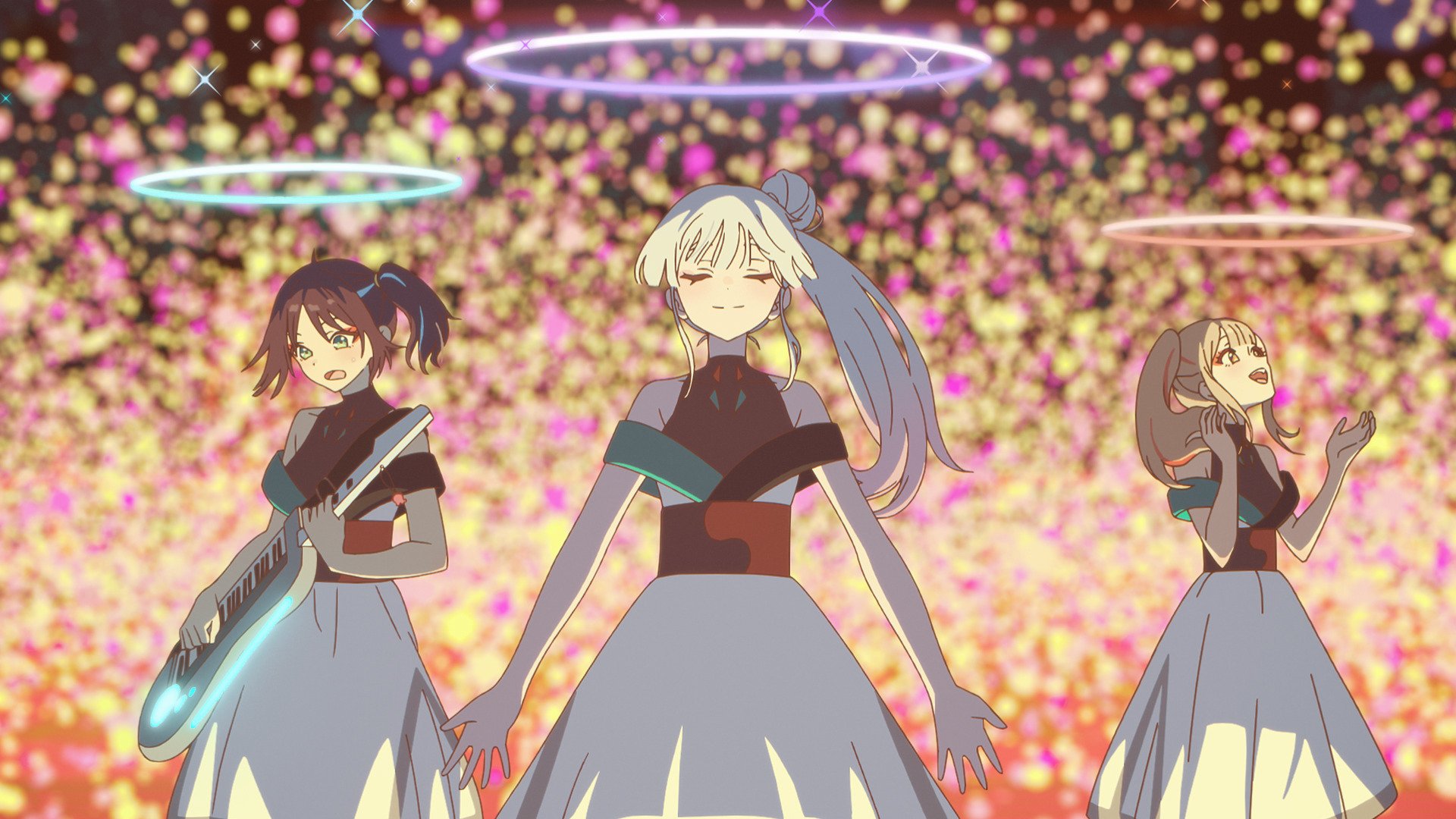
Within Tsukuyomi, Cosmic Princess Kaguya! builds a sparkling testament to gaming mechanics, idol fandom, and the creator economy. The platform’s innovative avatar customisation menus and skins mean wondrous animated costumes, hair, and makeup design, and players can tailor their in-game transports (why wouldn’t you and your friends all have matching tiger motorbikes online?).
The actual world-building of Tsukuyomi is fascinating to take in, all through cinematographer Daisuke Chiba’s dazzling shots. Creativity and popularity are the ultimate currencies in a world where “everyone’s a performer.” Players can earn both real-world money and in-game currency as creators by building their supporters, who buy tickets to tune in to livestreams of concerts held at Tsukuyomi venues. Notifications pop up in front of players to remind them of events, and virtual market stalls sell merch and food items, though taste and smell technology is still in development. And notably, there’s an entry-level tier that allows gamers to simply enjoy being unstressed and surrounded by abundance in the virtual world — “Even a broke girl like me can have all the fun she wants in here,” Iroha tells Kaguya.
Featured Video For You
But there’s also a major gaming element here, with performers gaining fame through streamed multiplayer online battle arena (MOBA) games with other players. There are even in-game news broadcasters and esports commentators. Events encourage players to earn supporters, with the Yachiyo Cup proving a core narrative propeller for the film — every streamer in Tsukuyomi competes to earn the most new fans in a month. The prize? A live collab concert with Yachiyo herself.
Here, Kaguya and Iroha come face to face with their competition: a trio of gamers called Black Onyx, led by popular streamer Mikado (Miyu Irino), with an army of supporters known as “Bunnies.” And it’s through this rivalry that we’re gifted one of the film’s very best sequences: a second-act showdown in a MOBA game that boasts some incredible combat choreography and quickfire editing by Ryōta Kinami. And it’s not the only jaw-dropping sequence.
Cosmic Princess Kaguya! is a feat of simply dazzling animation
Credit: Netflix
Cosmic Princess Kaguya! is the kind of animated adventure that leans into the genre’s possibilities, seeing physical space as something to be optimised and disrupted. Though the film’s animation is at its best within the neon and pastel virtual world of Tsukuyomi — where production effects aren’t constrained by physics — Yamashita also spends time offering up the beauty of the real world, as Kaguya and Iroha find spending time together IRL can be just as magical as their virtual adventures.
Yamashita also plays with animated genres throughout the film, dancing between various forms to fill backstory, from adorable 8-bit gaming sequences to a style akin to traditional Japanese scroll painting. And thanks to musical sequence director Naoya Nakayama, the Vocaloid songs shimmer through the screen. It’s this fluidity of stunning visual storytelling, high-energy editing, and a sense of limitless imaginative potential that makes Cosmic Princess Kaguya! such a vivid environment to experience. But at its core, our protagonists exude humanity, authenticity, and pure connection, two stars in a love story that transcends reality.
Though the tale may be classical, Cosmic Princess Kaguya! feels wildly contemporary, offering a brilliant modern take with an understanding of digital culture, fandom, and connection — online or off, Earthly or lunar.
Cosmic Princess Kaguya! is streaming on Netflix Jan. 22.
Mashable