

Webb telescope peels back the mystery of a stunning nebula
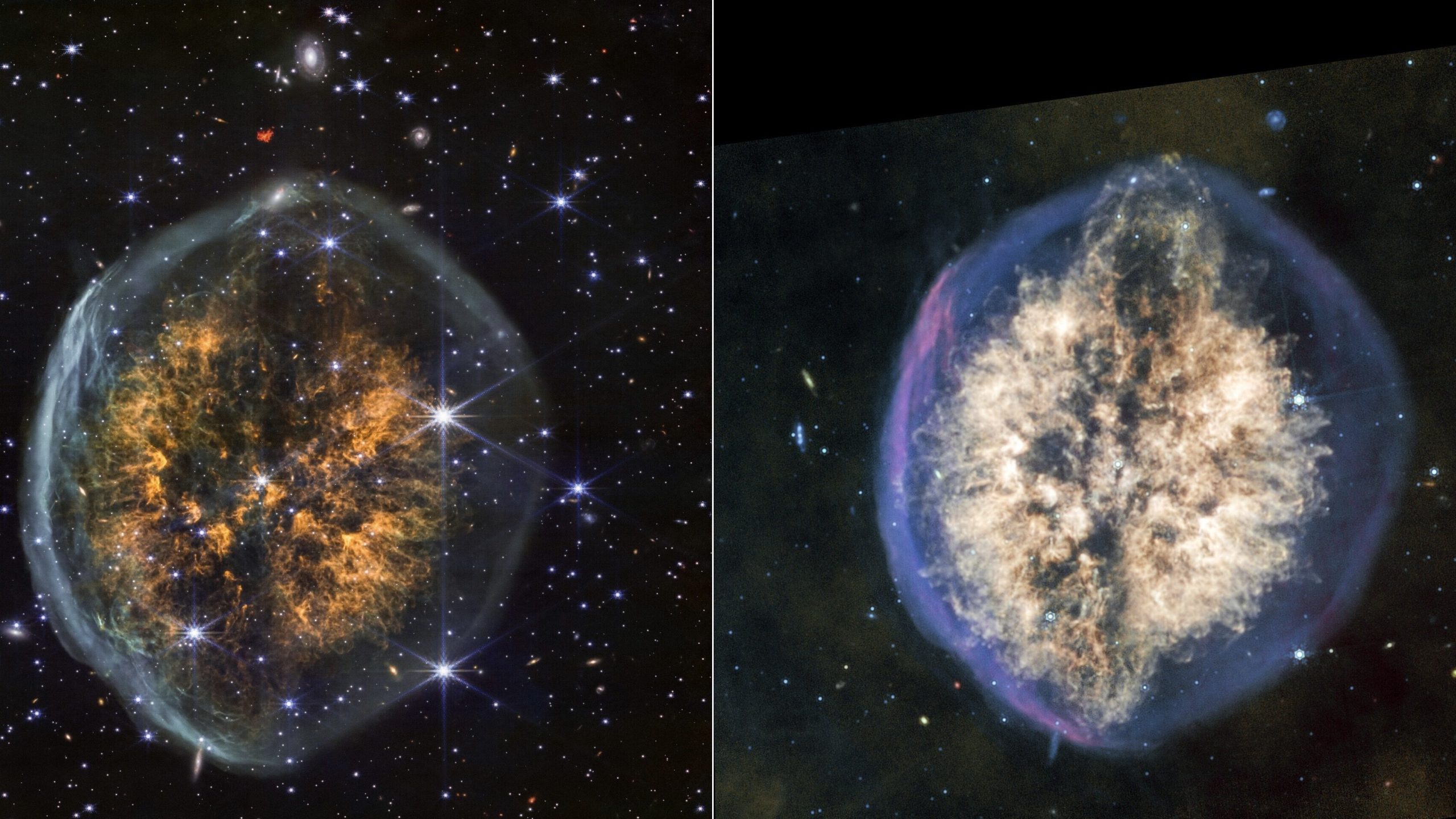
The James Webb Space Telescope has snapped new pictures of a cosmic cloud of gas and dust blown off by a dying star, whose fate is still unknown to scientists.
The telescope, a partnership of NASA and the European and Canadian space agencies, homed in on PMR 1, a planetary nebula nicknamed the Exposed Cranium for being the spitting image of a brain scan. The nebula lies about 5,000 light-years away from Earth in the Vela constellation.
Webb captured the object in infrared — light wavelengths that are invisible to human eyes but can pierce through thick dust. The new views, in both near and mid-infrared, sharpen details from the photos taken by NASA’s Spitzer Space Telescope more than a decade ago.
It’s not yet clear why researchers decided to point Webb in its direction, but little is known about the nebula, including the mass of the star creating it. That matters because a more massive star could eventually explode as a supernova, while a smaller, sun-like star would keep shrugging off layers of material until only a dense core remains and cools over time.
Beyond the cloud’s unusual shape, scientists see the nebula as a freeze-frame in the life of a star facing its final act. Elderly stars shed their outer layers in bursts, creating shells of gas and dust that expand. By observing the nebula at different wavelengths, researchers can sort out what material was molted first, how fast the star is losing mass, and which phase of decline Webb has caught.
A so-called “planetary nebula” is a confusing misnomer because these clouds have nothing to do with planets. As a medium-size star nears the end, it puffs out into a red giant — about 100 to 1,000 times its original size — eventually engulfing the space around it, including any nearby worlds.
When the star eventually releases its outer layers, it shrivels down to its core in what’s known as a white dwarf star. At that point, it’ll be about the size of Earth.
The images of the Exposed Cranium Nebula suggest multiple episodes of stellar outbursts. A dark lane runs straight through the middle, splitting the glowing cloud into two hemispheres, reinforcing its brainy likeness.
Don’t miss out on our latest stories: Add Mashable as a trusted news source in Google.
A faint outer bubble, made mostly of hydrogen, marks an earlier period of material sloughed off. Closer to the center, a more complex cloud of mixed gases forms the “brain” inside the shell. Webb’s instruments also show more dust glowing in mid-infrared light, while the near-infrared view lets background stars and even distant galaxies shine through.
Webb’s sharper view also hints at possible jets from the central star. The dark lane and the way gas appears to push outward near the top of the nebula suggest an ejection that may be shaping the cloud’s symmetry, a common feature when aging stars throw material in opposite directions.
For now, the images capture a brief, dynamic moment in a star’s death march, offering a rare peek at how its debris scatters through space, seeding future generations of stars and planets.
Mashable