

Is this the next big thing in music? Spotify is turning online fandom into real-life community
The first time I heard Phoebe Bridgers’ new album, Lost Weekend, I was sitting beside my sister beneath a sky full of stars, surrounded by roughly 400 of Bridgers’ biggest fans.
It was Aug. 13, one night before the album’s release, and Spotify had invited us to hear it inside the planetarium at the Liberty Science Center in Jersey City. Before we could hear the first baseline, however, everyone had to lock their phones inside magnetic Yondr pouches. Once we entered the planetarium, there would be no photos, videos, or notifications competing for our attention.
Credit: Spotify/Matt Grubb
With our phones out of reach, the lights dimmed and the album began. Footage of night skies and landscapes moved across the dome in time with the music: stars over Madagascar, the northern lights above Icelandic glaciers, and storms rolling across Texas. Created by photographer and National Geographic night-sky explorer Babak Tafreshi, the audiovisual show used footage captured across nearly 20 countries without computer-generated imagery.
The phone-free rule meant that everyone experienced the next hour together, from the first song to the last. Nobody could skip ahead, check what other fans were saying online, or pull out our Notes app when a favorite lyric hit.
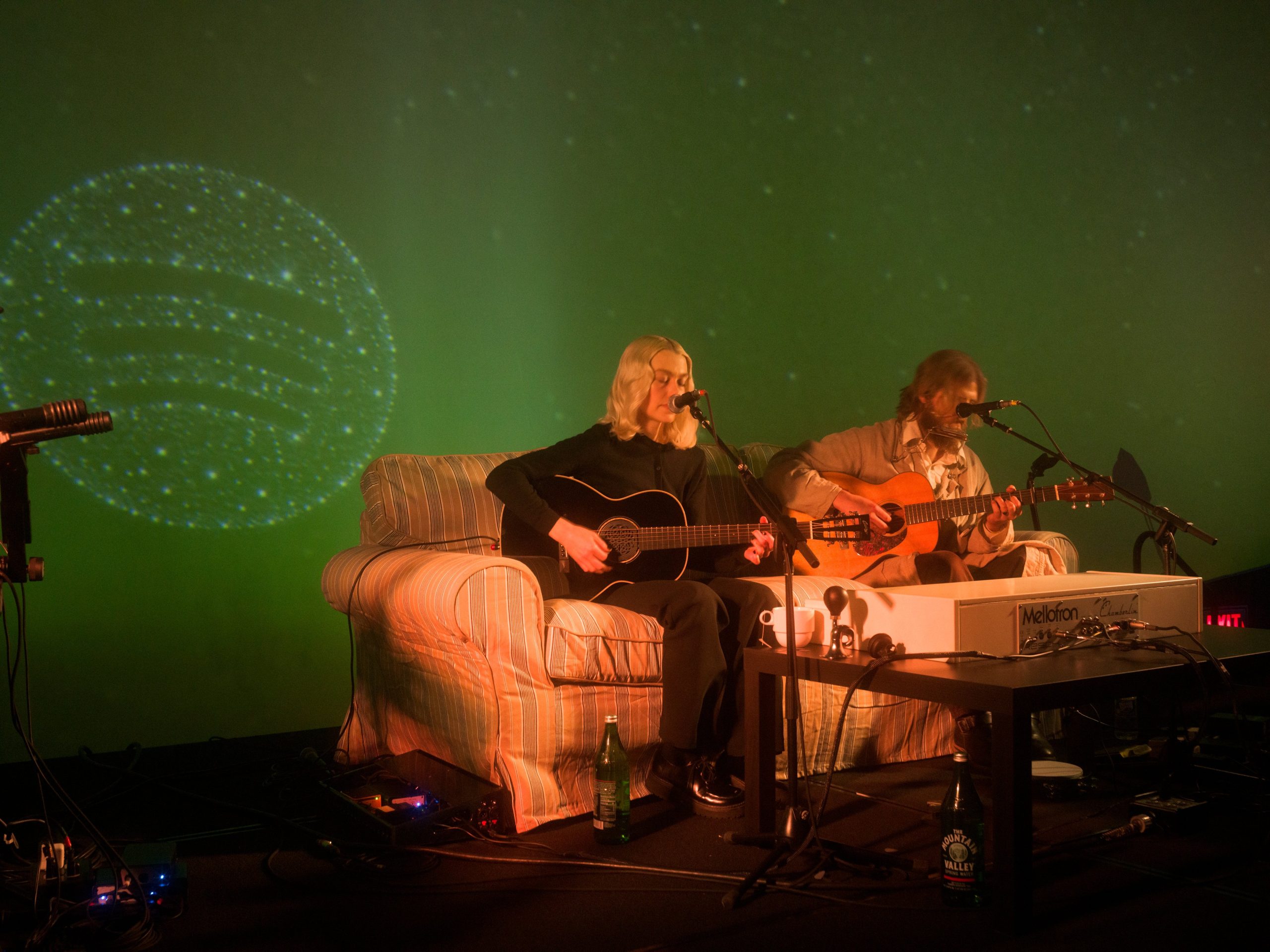
After the final song ended and the crowd wiped tears from their eyes in unison, Bridgers herself walked out for a surprise acoustic performance with longtime collaborators Christian Lee Hutson and Nick White. She played two songs from the new album, along with “Scott Street.” (Yes, my sister and I both cried). For those three songs, with no phones in the air and hundreds of fans completely locked in, the rest of the world could wait.
Credit: Spotify/Matt Grubb
The night was an unusually immersive album rollout, yes, but it reflected a broader shift in how music platforms and artists think about fandom.
After years of making music more personalized, portable, and solitary, listeners — especially younger ones — are looking for experiences that turn their online interests into real-life community. And, as more artists experiment with phone-free shows, it’s becoming clear that the future of digital fandom may depend on giving people more reasons to log off.
“They desperately want to connect with each other.”
Research backs up young adults’ appetite for more offline connection, while also showing why it can be difficult to satisfy. “They desperately want to connect with each other,” Psychologist Jamil Zaki said. “But they don’t realize everyone else wants that as well.”
At the same time, technology makes staying home the easier option, creating what he describes as “social inertia”: Young people may want to go out and meet one another, but each convenience gives them one less reason to do it.
Interest-based events can lower that barrier because everyone arrives with something in common. In a 2025 Eventbrite survey of 2,000 U.S. adults ages 18 to 35, 95 percent said they were interested in exploring their online interests through in-person events, while 84 percent of those who had attended interest-based gatherings said they had developed close friendships through them.
Spotify’s latest slate of in-person experiences taps into that same desire: KLUB KATSEYE invited some of the group’s top listeners to a party featuring a performance by KATSEYE, while a New York event with Charli xcx brought together music, fashion, and film.
Credit: Bryan Bedder/Getty Images
Credit: Terry Wyatt/Getty Images
The Lost Weekend listening experience will be featured at more than 40 planetariums around the world, with some showing Tafreshi’s dome presentation and others pairing the album with an immersive laser show created by Laser Fantasy.
Events like these are part of a broader effort by Spotify to make being a top listener count for more than just a spot in Wrapped. Through what the company calls its “fan-first” approach, Spotify uses listening activity to identify an artist’s most dedicated fans and offer them benefits such as early ticket access, exclusive merchandise, and invitations to experiences like the one my sister and I attended.
“Spotify is where so many fans start building their relationship with an artist, so we’re always thinking about how we can make that connection feel deeper,” Rene Volker, Spotify’s head of live events, told Mashable.
The company says its live-music tools have already helped drive more than $1.5 billion in ticket sales for artists, giving Spotify a role in the fan experience long after someone presses play.
“Whether you’re tracing the creative connections behind a favorite track with SongDNA, finding your next show with Concerts Near You, getting rewarded for your fandom with Reserved, or stepping into an artist’s world in a whole new way at one of our own live experiences, we’re constantly finding new ways to bring fans closer to the artists they love.”
“The phone-free aspect was legendary.”
For all the ways technology can help fans find one another, it can also follow them into the room. At concerts, attention is often split between the performance onstage and the recording of it for later, which can make sharing a physical space feel surprisingly disconnected.
This Tweet is currently unavailable. It might be loading or has been removed.
Bridgers has spent this album cycle encouraging those screens to disappear. The planetarium was not her first phone-free event: At a surprise Madison Square Garden show in June, fans had to secure their phones, cameras, smartwatches, and other devices inside pouches. Even pens and paper were prohibited as Bridgers tried to keep recordings and lyrics from her unreleased songs from immediately circulating online.
Many fans welcomed the restriction. “The phone-free aspect was legendary. One of the best concerts I’ve ever been to,” one attendee wrote in a Madison Square Garden Reddit thread. Another fan said they “couldn’t believe how well-mannered and present everyone was,” recalling people interacting and inventing games together while waiting in the merchandise line. Bridgers is now extending the same phone-free policy to her upcoming tour.
She is hardly the only artist rethinking the role of smartphones at concerts. Fred again.. covered fans’ camera lenses with stickers during a recent run of London shows, while Harry Styles made his one-night-only Manchester performance entirely camera-free and handed out disposable cameras instead. Bob Dylan, Jack White, and Ghost have required audiences to secure their devices inside Yondr pouches for full performances, while Lane 8’s shows have long been built around a no-recording rule.
Other artists have taken a less restrictive approach. Audrey Hobert performed her song “Sue Me” twice at Lollapalooza so audiences could put their phones away for the second performance, while Sabrina Carpenter has said she would consider banning phones from future concerts.
According to Eventbrite, phone-free experiences grew 567 percent globally between 2024 and 2025, while attendance increased 121 percent.
Phones are unlikely to disappear from concerts altogether, nor does every event need to ban them. But artists and fans alike appear hungry for a stronger sense of connection and increasingly willing to push back against the chronically online culture surrounding live music.
After all, who wants to watch a concert through a sea of other people’s screens? The best events are felt across a crowd, which may be why the next phase of digital fandom is less about keeping fans online and more about creating out-of-this-world experiences (pun intended).
Disclosure: Spotify invited Mashable to attend the Lost Weekend Planetarium Experience.
Mashable