

New photo reveals an asteroid view that a NASA spacecraft never saw
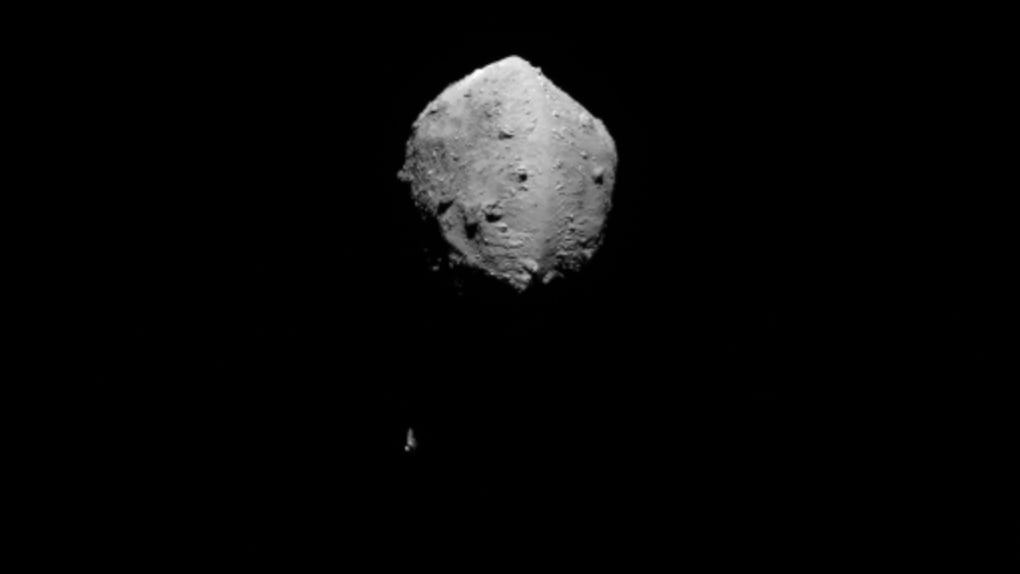
Europe’s Hera spacecraft just took its first close-up picture of Didymos and Dimorphos, the asteroid pair NASA used for target practice in 2022.
The European Space Agency mission is designed to do a sort of crash scene investigation following NASA’s DART mission, the first planetary defense rehearsal. DART, which stands for Double Asteroid Redirection Test, involved sending a 1,300-pound, refrigerator-size spacecraft straight for Dimorphos, the smaller asteroid orbiting Didymos, to see if a strike could change its trajectory in space.
The spacecraft’s hip check to Dimorphos seems to have worked, lopping 33 minutes off its orbit. But the change was more significant than scientists predicted, leaving open questions on the extent of the impact and why it unfolded the way it did.
The new black-and-white photo shows Didymos, which measures about a half-mile wide, from about 37 miles away. Shadow hides most of Dimorphos, its 500-foot-wide battered moonlet.
Hera’s view shows the side of Didymos that NASA’s spacecraft never saw before the crash. The “backside” looks remarkably different, according to the team, with boulders, craters, and grooves. It also shows the continuation of a ridge that wraps around the asteroid’s middle.
“The first thing we said was ‘Wow!'” said Patrick Michel, Hera’s principal investigator, in a statement. “This feels like looking at a whole new world.”
Some of these features may come from debris the crash blasted across the half-mile gap between Dimorphos and Didymos, said mission scientist Michael Kueppers. The space agency will release detailed images of both asteroids on Nov. 25.
The robotic spacecraft, about the size of a small car, flew for two years to reach the asteroids, which now sit about 122 million miles from Earth.
Scientists hope Hera’s findings will help turn “kinetic impact” — ramming a spacecraft into an asteroid to nudge it — from a one-time experiment into a reliable planetary defense tool, if Earth ever needs it.
Want more science and tech news delivered straight to your inbox? Sign up for Mashable’s Top Stories newsletter today.
When DART hit, it blasted rock and dust into space, and that spray pushed the asteroid like a rocket’s exhaust. Scientists call this extra kickback the “beta factor,” and Hera will help measure it. That number could tell future mission planners how hard they’d need to punch a killer asteroid (unlike Dimorphos, which posed no threat) to move it out of Earth’s way.
But before scientists can answer that, Hera has to see what DART left behind. The spacecraft will map the crash site to learn whether the collision caused a deep crater, left a shallow dent, or changed the asteroid’s whole shape.
Credit: ESA illustration
Scientists also want to know if the impact knocked Dimorphos into a wobble. Before the crash, Dimorphos always kept the same face toward its larger partner, the way our moon does with Earth. Telescope data now hint that it may be tumbling.
Hera’s small companion probe, Juventas, will scan the interior with radar, sort of like taking an X-ray, to look inside the asteroid. Meanwhile, Hera will measure the asteroid’s mass and density to show how tightly it’s packed. Dimorphos might be a single solid rock, or it might be a loose pile of boulders with empty gaps between them.
Its composition could explain why it reacted the way it did during the collision. Gravity on Dimorphos is about 200,000 times weaker than on Earth, so even the tiny forces that make particles stick together could affect how the asteroid holds up under a hit.
“We have an exciting work ahead of us to sort it out,” Kueppers said. “We look forward to seeing much more of both bodies and systemically mapping all the changes we identify.”
Mashable