



Scientists caught stars eating their young planets because of this clue
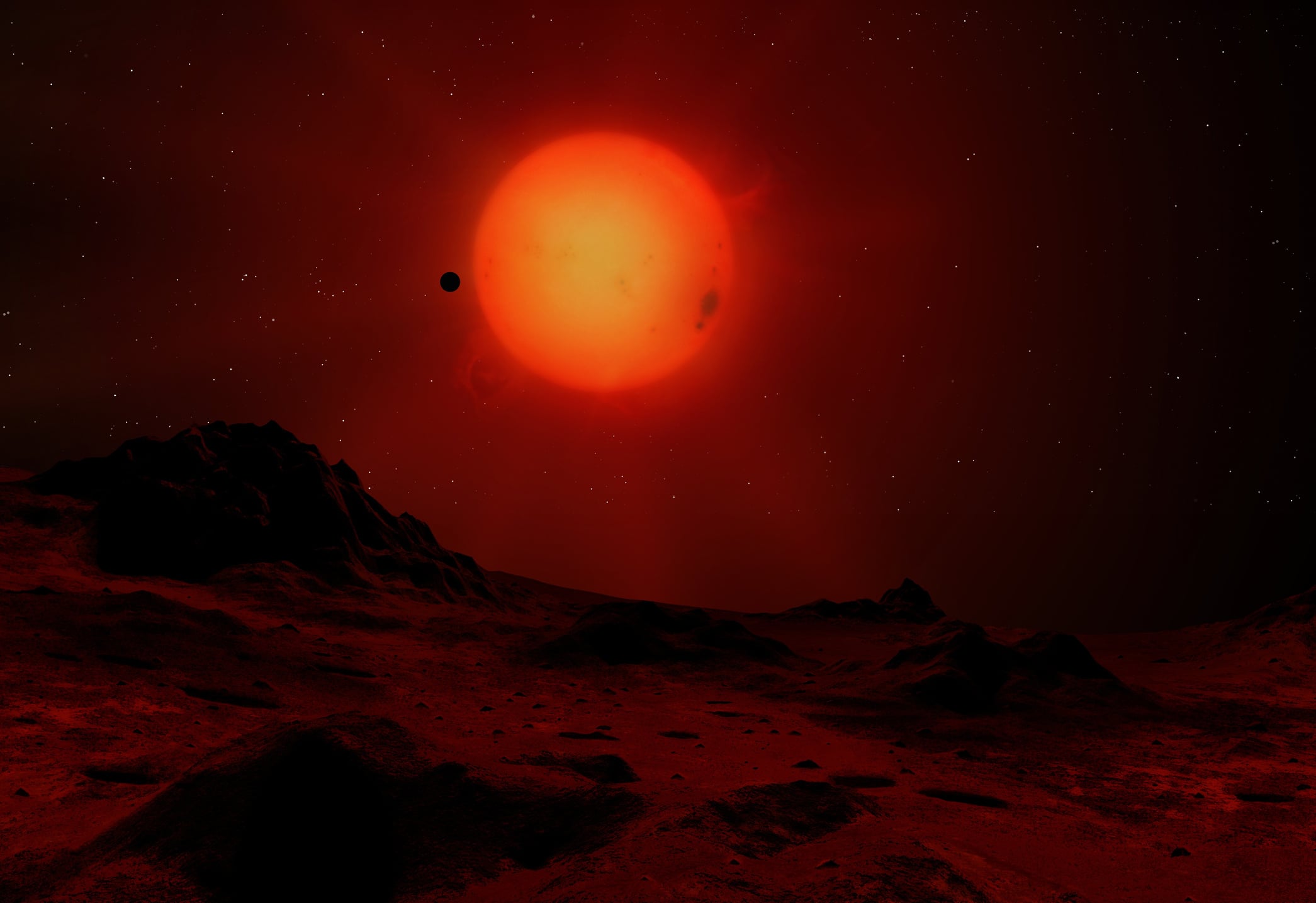
Based on a strange clue, astronomers have found a collection of young red dwarf stars in space that may have gobbled up rocky planets — perhaps similar worlds to Earth.
Like sniffing a teenager’s breath for alcohol or cigarette smoke, researchers noticed the stars had more lithium in their atmospheres than they should. That could mean they still had the stench of their last meal on them.
A red dwarf is a small, cool type of star, and lithium is a lightweight chemical that stars eventually destroy through nuclear reactions. In stars like these, lithium usually disappears early in life because the stars’ hot interiors incinerate it. By the time these stars reach adolescence — around 50 to 200 million years old — astronomers expect little to no trace of lithium.
But a team found six stars out of thousands surveyed that broke the rules in a new study published in Monthly Notices of the Royal Astronomical Society. These stars contained much more lithium than other stars of the same age in their clusters, said Robin Jeffries, lead author of the paper, from Keele University in the United Kingdom. The lithium-rich stars made up only about 2 to 3 percent of stars in that temperature range, making them rare but not flukes.
“Even a small amount of lithium stands out clearly in these stars — a bit like throwing paint onto a blank canvas,” Jeffries said in a statement.
Astronomers already knew stars could swallow planets, but the evidence has usually come from faint, debatable chemical detections. This study may have found a much clearer signal: young red dwarf stars somehow regained lithium, likely by swallowing several Earths’ worth of rocky planet material that contains the element.
The findings suggest planetary systems — especially around red dwarfs — may go through a far more tumultuous childhood than astronomers realized. Instead of forming neatly and staying put, rocky worlds may regularly collide, scatter, or spiral into their stars during the first few hundred million years.
That matters because red dwarfs are the most common stars in the Milky Way and host vast numbers of Earth-size planets, including many in potentially habitable zones, where temperatures are not too hot or cold for liquid water on their surfaces. If those rocky exoplanets are sometimes eaten by their stars, that may mean some Earth-like worlds die before they could have a chance to spark life.
Credit: ESO / H.H.Heyer
Other than the presence of lithium, the stars looked normal. They sat in the same locations as other cluster members, moved through space the same way, and appeared to be about the same age. That ruled out the possibility that they were just younger stars mixed into the sample.
The researchers did consider other explanations for the chemical. One idea involved magnetic activity because strong magnetic fields and starspots can sometimes slow lithium destruction in young stars. But that explanation wasn’t a good fit because most of the lithium-rich stars spun slowly; fast rotation usually links to stronger magnetic activity.
Another idea suggested the stars kept feasting from their birth disks for an inordinate length of time. But the team thought that scenario probably wouldn’t preserve enough lithium. That left planet swallowing as the leading explanation. Rocky planets contain lithium, so devouring them would temporarily spike the lithium level in the star’s outer layers.
The team estimated each star may have swallowed material equal to about three to 10 Earths.
That may sound extreme, but astronomers already know many red dwarf stars host compact systems packed with rocky planets. Computer simulations also show that young planetary systems often become chaotic. Gravitational interactions can fling planets inward until the star engulfs them.
Researchers think these events likely happened after the stars stopped rapidly destroying lithium. Depending on each star’s mass and inner workings, their lithium signatures could now remain for millions of years.
Mashable