

The Last House ending, explained. Because what?
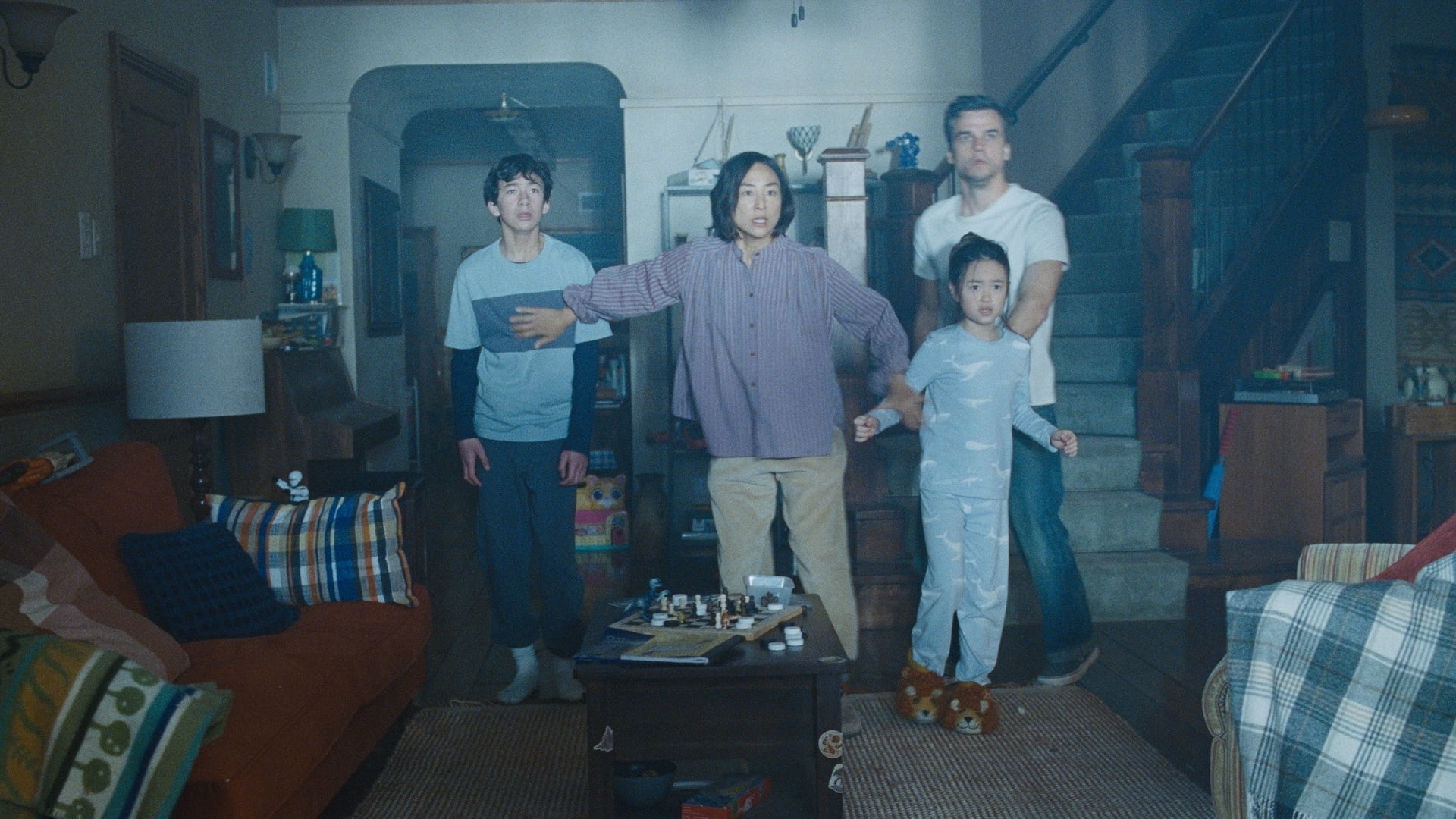
Well, that was a bleak and bonkers two hours.
Netflix’s The Last House might be one of the most baffling films on the platform in an age, as a certified genre Rolodex that blends The Call of Cthulhu with Home Alone and the overwhelming essence of COVID lockdowns. By the end of the movie, from director Louis Leterrier (Now You See Me), The Secret Agent Oscar-winner Wagner Moura and Past Lives Oscar-snubbed Greta Lee have seen their family through five years of imprisonment in their own home thanks to some malevolent waterbending.
But what actually happens at the end of The Last House? Well, I’m still thinking about the family dog in the freezer, but I’ll break it down.
What happens in The Last House?
Credit: Netflix
In a set-up not unlike Netflix thriller Brick, The Last House sees a Seattle family suddenly sealed inside their own home. Unlike Brick, the sealing happens during an extreme rainstorm, with the locks bolted by tendrils of water itself. And it’s not just the home of Ann (Lee) and Jason (Moura) and their children Ruth (Riley Chung) and Graham (Noah Alexander Sosnowski) — it’s the whole neighborhood.
Scenes of being trapped inside might trigger memories of COVID lockdown for viewers, especially as the family tries homeschooling their stir-crazy kids and watching Annie and Air Force One on DVD on repeat. But things for this family only get more grim as they face starvation in their own home, then shoot their sickly Golden Retriever, Cassidy, freezing her for sustenance. Then, Jason goes all Caractacus Potts on the neighbourhood wildlife with “chimney fishing.” Honestly, watching the Animals of Farthing Wood getting butchered one-by-one was not on my weekly agenda.
Days stretch into weeks, into months, then five years later, the family seems to be the “last house” on their street that’s still got living residents inside. That’s chiefly through Jason’s ingenuity in collecting rainwater and setting animal traps through their chimney, and Ann’s resourcefulness in growing a farm’s worth of vegetables in the living room.
Why can’t the family leave their home in The Last House?
Credit: Netflix
While the neighbors initially speculate it’s the government or aliens causing this involuntary lockdown, it’s neither. Essentially, the family is trapped by tentacled deep sea creatures, who look like Cthulhu, but smaller. They’re less towering titans and more the height of a pro basketball team.
But are they actually monsters? Ruth (Emma Ho), who is ultimately revealed to be the film’s narrator, doesn’t think so. Early on, she tells her family that one of the creatures she saw outside “seemed nice” and was “trying to communicate.” Jason has his own enigmatic experience, as the seemingly sentient rain takes the shape of his palm against the window pane.
Not all of the creatures seem so friendly; however. Aside from starving out their neighbors, the creatures also snatch up the long-lost jogger from the start of the film, as she tried to get into the family’s home for safety. Later, the family gets their best view yet of these mysterious creatures, when one enters the house, and splashes salt water all over their crops, killing the lot.
From there, Ruth insists these creatures aren’t aliens, but fabled deep sea creatures like Leviathan or the Kraken.
“80 percent of the ocean is unexplored,” she explains, “What if these things aren’t from outer space? What if these tales of sea creatures are real? What if that’s why they can control the rain? They’re not conquering our world. This is their world.”
And that’s the only explanation we ever get. So why do the creatures kill off a bunch of Seattle residents? As the film starts in the shallows of the coast, which is littered with human debris, we might infer that the creatures are wiping out humanity to reclaim the planet, preventing further damage to their environment.
What happens at the end of The Last House?
Credit: Netflix
The next time a creature comes calling, the family is ready with Home Alone-style booby-traps, molotov cocktails and harpoons. Once trapped, Jason threatens it, demanding, “Open the door, or I’m gonna gut you.”
However, Ruth begs for her father to let it go, he does. And this act of mercy leads not only to the family being let out of the house, but also the creature signaling to its squad to give the family mercy in return. So, as the foundation in the house — much talked about — finally gives way, the sun comes out, and five creatures scoot away underwater in a flying V across what used to be Seattle, flooded so high the Space Needle is practically a dock.
From there, the family steals the boat of a dead neighbor they rudely ridiculed before lockdown as a “doofus,” rename the man’s boat from “Seas The Day” to “Cassidy,” to honour the family dog they ate, and literally sail into the horizon.
Featured Video For You
“In the end, an act of mercy set us free. We showed it to them, and they showed it to us,” Ruth, now an adult (and voiced by KPop Demon Hunters‘ Arden Cho) says in voiceover, as the film takes a decidedly Disney Channel tone out of nowhere. “We never saw them again but we think they’re still out there. After all, it’s their home too.”
The Last House ends with the family on “Day 1” of their new existence, searching for a new home and any other humans that may have survived the five years of octopus occupation.
The Last House offers no clue to how far this nautical attack reached. It’s also unclear how exactly the waterbending powers of these creatures work. If they can control all water, couldn’t they have skipped the whole lockdown scenario and controlled the 60 percent of the human body is water to destroy us? But then, I guess you don’t get to the point of grim where you’re rationing the family pet for sustenance.
Let’s look away from the nonsense of Matthew Robinson’s script, and look to the horrid statistics that likely inspired it.
Every year, an estimated 130 million tons of plastic waste pollute waterways and seas. Microplastics are a plague on the planet, showing up in microscopic krill. The Great Pacific Garbage Patch is 100,000,000 kilograms’ worth of our crap and twice the size of Texas. And by 2050, estimates predict there could be more plastic in the ocean than fish.
The Last House‘s point might have been more impactful if it mentioned literally any of this. But perhaps our treatment of the ocean means we deserve a movie this atrocious.
The Last House is now streaming on Netflix.
Mashable