


Webb reveals a pink alien world wrapped in salt clouds
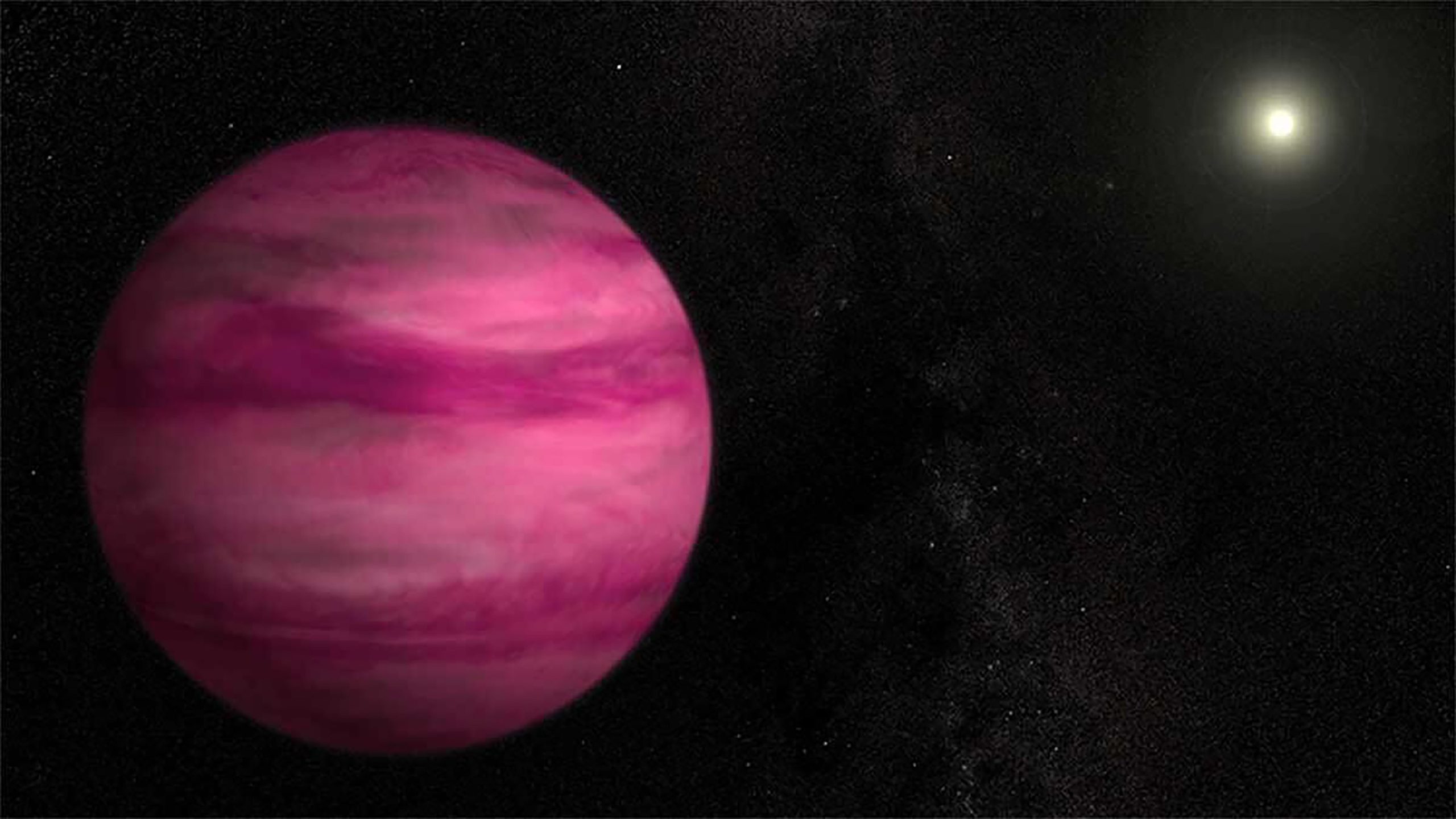
An enormous world orbiting a sun-like star just 57 light-years away in space may have a pink hue and a sky filled with clouds of salt.
Astronomers used NASA‘s James Webb Space Telescope to study a distant object called GJ 504 b, and for the first time, detailed in a new study, they captured its light in enough detail to study its atmosphere directly rather than relying on rough brightness calculations.
“Distant object” is about as precise of a label as it gets for this thing. Despite the Pink Planet nickname, astronomers aren’t even sure what it is. Some studies have suggested it might be a giant exoplanet, while others argue it could be a brown dwarf, a sort of failed star too small to generate its own nuclear power. For now, astronomers are comfortable calling it a “planetary-mass companion.”
The problem is that GJ 504 b is cold, faint, and difficult to study. But with Webb, researchers finally had a chance to gather a spectrum, a technique that splits the world’s light into its component colors. The presence or absence of different shades can reveal the mix of elements in its atmosphere.
The most striking finding was that this place has clouds — and not just any clouds — salt clouds. Though previous work has theorized salt clouds should be able to form in worlds between 400 and 1,200 degrees Fahrenheit, astronomers haven’t really found evidence of them over the past 15 years, said Aneesh Baburaj, a Northwestern University astronomer, who led the study.
“Salt clouds are unusual,” Baburaj told Mashable. “GJ 504 b provides some of the first evidence that salt clouds exist in the atmosphere of such cold objects.”
At roughly 550 degrees Fahrenheit, GJ 504 b might not seem cold. But compared to most directly imaged exoplanets, that temperature is quite balmy.
The researchers attribute the lower temperature to its age. While most gas giant planets are extremely hot at birth, they cool over time. The new study estimates GJ 504 b is 2.5 to 4 billion years old.
Credit: iStock / Getty Images Plus illustration
As for those salt clouds, the salt is not table salt or even Pink Himalayan Rock Salt, though that would go splendidly with the theme. The paper, published in The Astronomical Journal, describes them as clouds made from tiny particles that form when gases cool down just enough to condense into solids or liquids.
On Earth, clouds form when water vapor condenses into droplets that drift through air. But on GJ 504 b, the same process happens with far more extreme ingredients. The atmosphere contains gases that can combine into mineral-like compounds at high temperatures, and when conditions shift, those compounds condense into microscopic grains. Those grains then float through the atmosphere and scatter light.
These clouds are likely made of alkali metal compounds, such as potassium chloride, or perhaps sulfide compounds, like manganese sulfide.
“We do not have enough evidence to say exactly what kind,” Baburaj said.
The cloud layer likely plays a major role in the GJ 504 b’s appearance. The team describes a faint pinkish tone in the way the light travels through the atmosphere. That means GJ 504 b might not shine pink, per se, but its atmosphere filters its star’s light in a way that leaves a faint warm tint in the spectrum.
Despite the new detail provided by Webb, astronomers still haven’t settled the debate over whether the Pink Planet is indeed a planet. The chemical evidence appears richer in heavy elements, like carbon, than its host star. That pattern often shows up in planets that form within a disk of gas and dust around a young star. But there are enough uncertainties that the researchers still can’t rule out its being a brown dwarf.
If it is a planet, it’s one that weighs about 25 times more than Jupiter, the most massive planet in our solar system.
Mashable